
5G: A Game-Changer for Broadband?
Demystifying 5G Broadband: What It Is and Why It’s Different
The start of 5G technology has ignited a wave of excitement and anticipation, with promises of faster speeds, lower latency, and greater capacity. While primarily associated with mobile devices, 5G is set to reshape the broadband landscape as well.
In 2025, conversations around broadband in the UK have rapidly shifted from “Can I get fibre?” to “Should I go 5G?”. This guide delivers an up-to-date deep dive, in the clear, unbiased, consumer-friendly style. Understanding what 5G broadband offers and where it’s truly available is essential for your next broadband switch. In this comprehensive guide, you’ll find:
- A plain-English breakdown of what 5G broadband is and how it works
- Side-by-side comparisons: 5G vs fibre, tech specs, costs, and more
- Expert look at speeds, latency, and device capacity
- The leading UK 5G broadband providers, their latest deals, and setup processes
- Real-world coverage and regional variations
- Top consumer use cases and FAQs
- Pro tips for SEO-driven headings and responsive content formatting
- A look ahead at future tech trends and what’s next for UK connectivity
Let’s bust through the jargon and marketing fluff – here’s what UK consumers really need to know about the shift to 5G.
At its core, 5G broadband simply means getting your home (or mobile) internet over the fifth generation of mobile network technology. Like 3G and 4G before it, 5G uses radio waves and masts but with a huge leap in speed, capacity, and response time, making it suitable for true broadband at home, not just for your smartphone on the move.
How 5G Broadband Works
- A 5G router is fitted with a 5G SIM card, similar to a mobile phone, authorised on a suitable data plan.
- The router connects wirelessly to the nearest 5G mast, receiving the mobile signal and converting it into a WiFi network or direct cabling for your home devices.
- No physical landline or fibre cable is needed. Setup is typically “plug and play” – just power up, enter WiFi details, and you’re online
The consumer effect? If you have decent 5G mobile coverage at your address, you can get ultrafast broadband without booking an engineer or paying for a phone line you never use.
Home vs Mobile 5G Broadband
- Home 5G Broadband: For fixed locations. Router stays at home, powered via mains, supports 64+ devices.
- Mobile 5G Broadband: Compact, battery-powered “MiFi” or “hotspot” devices. Take it on the road – great for students, travel, or small businesses needing internet on the go
What Makes 5G Special? Key Advantages Over 4G and Older Mobile Internet
5G isn’t “just a bit faster.” Compared to its predecessors, it brings:
- Much higher download and upload speeds (commonly 100–250Mbps, with peaks over 800Mbps in tests)
- Lower latency (response time often 20–35ms, close to fibre and excellent for gaming or video calls)
- Greater capacity (connect dozens of devices in a crowded home without slowdowns)
- Plug-and-play setup (no landline, engineer, or drilling holes)
- Truly portable and flexible (easier for renters/students/changing addresses)
For many UK households, 5G is the first mobile network that rivals home fibre broadband for speed and, in many regions, beats older “fibre-to-the-cabinet” or copper lines hands down.
For those making do with FTTC (fibre to the cabinet), 5G broadband often means a huge leap forward in speed and a break from frustrating ‘last-mile’ copper bottlenecks.” – [5g.co.uk analysis, April 2025]
Related Articles

Cookie Theft Hacks Bypass MFA: Cybercriminals Hijack Email Accounts Using Browser Cookies
Cybercriminals Exploiting Browser Cookies to Hijack Email Accounts, FBI Warns In a startling development, cybersecurity experts are alerting the public to a sophisticated hacking technique that allows cybercriminals to seize control of email accounts by stealing browser cookies even when Multi-Factor Authentication (MFA) is in place. Recent reports highlight that hackers are targeting the cookies […]
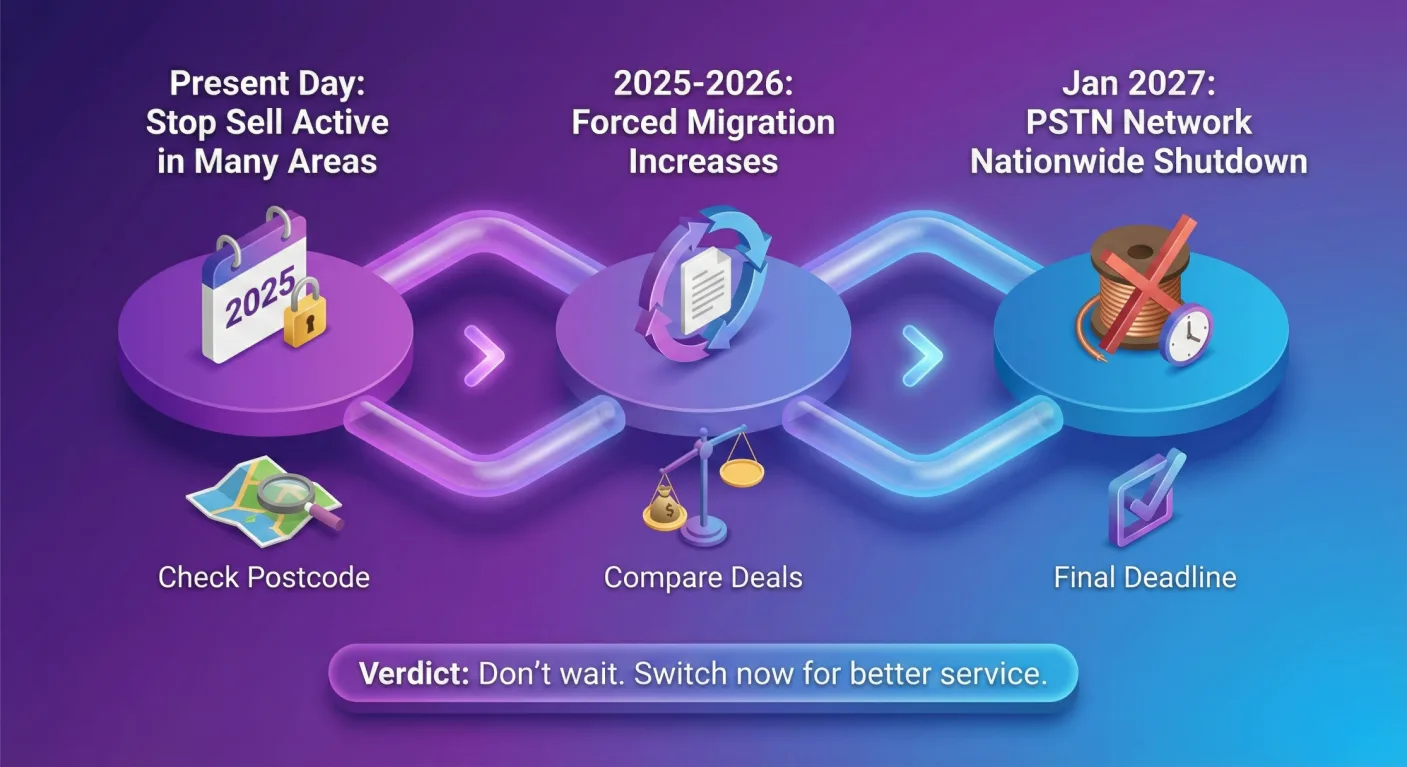
UK Copper Switch-off – What You Need to Know
The UK Copper Switch-Off 2026 Will Your Broadband and Landline Stop Working? Yes, your traditional landline’s disappearing. If you currently plug your home telephone directly into the rectangle wall socket, your service is going to stop working before 2027. The UK Copper Switch-Off isn’t a suggestion. It’s a mandatory infrastructure migration managed by Openreach that […]
5G vs Fixed Line (Fibre) Broadband Comparison
While 5G’s “no cables” set-up is appealing, how does it actually stack up against standard fibre and full-fibre (FTTP) broadband? Here’s an at-a-glance look below.
| Metric | 5G Broadband | Full Fibre (FTTP) | Fibre to Cabinet (FTTC) |
|---|---|---|---|
| Typical Download Speeds | 100-250Mbps (peak >800Mbps) | 300-1000Mbps | 40-80Mbps |
| Peak Download Speeds | Up to 1Gbps (theoretical 20Gbps) | 1–(future-proof) | 80Mbps |
| Latency (ms) | 20-35ms (some tests ~10ms) | 10-20ms | 15-40ms |
| Setup Time | Plug-and-play; self-service | Engineer visit, socket & cables | Engineer visit or self-service |
| Landline Needed | No | No (but can bundle with calls) | Sometimes |
| Monthly Costs (2025 typical) | £19-£50 (unlimited data) | £30-£55 | £20-£30 |
| Upfront Fees | £0-£150 | £0-£50 | £0-£50 |
| Installation Delay | None (next working day delivery) | May wait 1-2 weeks for engineer | Similar |
| Flexibility | Take with you (within 5G zones) | Fixed | Fixed |
| Contract Lengths | 1-24 months (short options common) | 18-24 months | 18-24 months |
| Coverage | Urban: excellent; Rural: limited | Growing; rural roll-out ongoing | Very wide |
If you have access to full-fibre, it may offer faster and more consistent speeds, but if not, 5G can be a vastly superior and less-hassle alternative to legacy broadband, especially in rental properties or where quick setup is needed.
5G isn’t perfect, performance can vary more depending on local network congestion, home construction (thick walls can block mobile signals), and mast proximity.
Leading UK 5G Home Broadband Providers: Devices, Deals & Key Features
The UK’s major 5G broadband brands are now Three, Vodafone, EE, and National Broadband (which acts as an aggregator and reseller of the best local mobile network for your address). Each offers both “home” and “mobile” 5G broadband kits.
Here’s how their home broadband offers compare as of August 2025:
| Provider | Main Device | Avg. Speed (Mbps) | Contract Term | Upfront/Setup Cost | Monthly Price | Data Allowance |
|---|---|---|---|---|---|---|
| Three | Three 5G Hub (ZTE/TP-Link) |
150-250 | 24/1 month | £0 | £19 (24m)/£28 (1m) | Unlimited |
| Vodafone | GigaCube 5G | 150-200 | 24m/1m | £15-150 | £30-£58 | 200GB/Unlimited |
| EE | Smart 5G Hub (Askey HH20C) |
146-240 | 18-24m/1m | £100 (Smart Hub) | £45-£50+ | 500GB/Unlimited |
| National Broadband | TP-Link 5G NX200 v1 | 100-200 | 12/18/24m | £49-99 | £39.99-£49.99 | Unlimited |
Key features to note:
- Unlimited data is now the norm for home 5G broadband (EE, Vodafone, Three, National Broadband all offer this)
- All top providers offer plug-and-play routers with WiFi 6 (with some already trialling WiFi 7) – no engineer visit
- Three and National Broadband are consistently rated best on value and speed, with Vodafone and EE often pricier (but with perks, e.g., extra security, WiFi boosters)
- Typical real-world speeds: 150 – 240Mbps for most users; peak lab speeds can be much higher in ideal conditions
Mobile broadband: All four providers also support mobile 5G routers (“Mi-Fi” or “hotspot”): Smaller, battery-powered – great for students or portable work, but coverage and device capacity are lower.
Equipment and Set-Up
Getting started with 5G broadband is generally quick and easy:
- Your new router arrives in the post: Already paired with a 5G SIM and, depending on provider, pre-configured.
- Plug in the power: Typical UK three-pin mains, no specialist sockets needed.
- Find a good spot: For best speeds, place the device near a window or high up (avoiding thick walls).
- Connect your devices via WiFi (or Ethernet): Use credentials from the router label or app.
- Check with the provider app or web dashboard: Some routers include a built-in tool to show best locations for reception.
- Advanced setups: Outdoor units (e.g., Three Outdoor Hub) can be fixed to a wall by a technically competent user or engineer for maximum signal, particularly in homes with poor indoor reception.
Equipment Features Table
| Device | WiFi Standard | Ethernet Ports | Device Connections | Antenna Support | Smart App |
|---|---|---|---|---|---|
| Three 5G Hub | WiFi 6 | 2 | Up to 64 | Yes (ext. antenna socket) | Yes |
| EE Smart Hub | WiFi 6 / 7 | 2 | 100+ | Not specified | Yes |
| Vodafone GigaCube | WiFi 6 | Yes | Up to 64 | Yes | Yes |
| National BB WiFi Router | WiFi 6 | Yes | Up to 64 | Yes | Yes |
With nearly all hardware, setup takes under 30 minutes – or less, if you’re simply plugging in and connecting devices.
How Fast Is 5G Broadband in Reality? UK Performance Data for 2025
Despite some optimistic adverts, what do real-world speed tests say? Here’s the current UK data as of summer 2025:
| Provider | Median Download (Mbps) | Median Upload (Mbps) | Median Latency (ms) |
|---|---|---|---|
| Three | 236.25 | 12.94 | 29 |
| Vodafone | 149.8 | 11.55 | 31 |
| EE | 100.56 | 11.97 | 30 |
| O2 | 73.86 | 8.46 | 33 |
5G still lags behind “full fibre” in top-end speeds and latency, but easily beats most FTTC and older connections. Some providers (notably Three and National Broadband) are offering peak speeds in certain areas as high as 300-800Mbps, but this varies sharply by postcode and signal strength.
Real-World Coverage and Regional Breakdown: Where Is 5G Available?
- Urban 5G coverage is widespread and strong—London, Manchester, Birmingham, Glasgow, and most large towns now have full signal from at least one major provider.
- Suburban areas see reasonable coverage, although “black spots” still exist.
- Rural and coastal communities: Coverage is expanding but less consistent. Only about 42% of rural sites report 5G access by summer 2025
ONS 2025 Regional 5G Coverage Data Highlights
| Area Name | 5G Coverage (%) |
|---|---|
| London (various boroughs) | ~100% |
| Manchester, Birmingham, Leeds | 98-100% |
| Glasgow City | 100% |
| Aberdeen City | 98.1% |
| Cornwall, Scottish Highlands | 10-30% |
| Na h-Eileanan Siar, Orkney, Shetland | 11-14% |
Use Cases: When 5G Broadband Makes the Most Sense
5G broadband is ideal for:
- Renters and students—no landline or fixed cables, easy to move
- Temporary setups (relocation, life events, home renovations)
- Homes without a good fibre/ADSL/cable service
- Households with lots of simultaneous streaming/gaming/videoconferencing
- Digital nomads—take your connection with you (within UK urban/suburban 5G areas)
- Backup or failover for businesses (automatic 4G/5G fallback is possible)
Less ideal for:
- Homes in deep rural areas may lack a 5G signal or speed consistency.
- Extremely heavy upload tasks (video pros may still prefer FTTP)
- Large “smart homes” with dozens of IoT devices in fringe coverage (latency may vary)
Case Example Table
| Use Case | Why 5G Works Well | When to Consider Alternatives |
|---|---|---|
| Renters/Mobile Households | No install, bring-your-own-router, no landline | If full-fibre available & home is permanent |
| Gamers & Streamers | Low latency, plenty of bandwidth | FTTP offers lower ping for esports-grade gaming |
| Work-from-Home | Fast upload/download, quick set-up | Mission-critical work may demand FTTP in very busy neighbourhoods |
| Rural Home/Business | Only if strong local 5G signal; quick fix when fibre build is pending | Slow/patchy in remote or hilly terrain |
Technical Metrics: Speed, Latency, and Device Capacity
In-depth metrics for power users:
- Download/Upload Speeds: Real-world 5G: 100–250Mbps; Peak: >850Mbps recorded (Three, EE in urban zones)
- Latency: 20–35ms median (very good for online gaming, HD streaming, and video calls)
- Device Support: Up to 64–100+ devices per hub/router (more than most UK homes will ever need)
- Capacity: Typically WiFi 6 (802.11ax) or WiFi 7 in 2025; supports dense home environments
Real-World Speed Table (2024–2025 national reports)
| Network | Average Download | Peak Download | Latency |
|---|---|---|---|
| Three | 205.5Mbps | 853.4Mbps | 29ms |
| EE | 99.5Mbps | 753Mbps | 30ms |
| Vodafone | 114.3Mbps | 545.6Mbps | 31ms |
| O2 | 77.0Mbps | 301.2Mbps | 33ms |
Frequently Asked 5G Broadband Questions
Is 5G faster than fibre?
In many cases, 5G now outpaces copper-based FTTC and some “superfast” fibre deals. Full-fibre (FTTP) beats 5G for raw speed and latency where available, but many UK addresses lack FTTP.
Do I need a landline for 5G broadband?
No. 5G broadband is entirely wireless - no engineer, no lines, no phone socket.
Can I get 5G everywhere?
Only in areas with established 5G mobile network coverage. Use address-level provider postcode tools, not generic area guides, before ordering.
Can I test 5G before committing?
Yes. Three and others offer 30-day return policies, so you can test speeds and performance at your location risk-free.
Is 5G Broadband setup hard?
For most, no - plug in, connect, and you’re done. Consider outdoor antennas/routers in homes with weak indoor reception.
Further reading on 5G Technology