
Who is the best broadband provider in UK in 2026
Who Is the Best Broadband Provider in the UK?
 There’s no single broadband provider that is best for every UK home. Ofcom and Expert Reviews measure different parts of the customer experience. Plusnet is my strongest all-round shortlist pick, while Vodafone, Sky and Virgin Media each show strengths in particular measures. Check what is available at your address, then choose the provider whose strengths match what matters to you.
A provider can have a short Ofcom complaint queue and still leave some customers unhappy with reliability or support. Another can win a customer survey without being available on your street. The useful answer comes from looking at the evidence side by side and being clear about what each result measures.
I would start by shortlisting Plusnet for its broadly strong results, but I would not choose it without checking local availability, price and package fit. Vodafone was Expert Reviews’ overall winner. Ofcom’s latest quarterly data puts Virgin Media, Sky and Plusnet in its lowest-complaint group.
At a glance
- Plusnet is the strongest all-round shortlist choice in the evidence reviewed here. It performed well across Ofcom’s service measures and Expert Reviews’ 2026 survey.
- Expert Reviews named Vodafone its 2026 overall winner. Plusnet was highly commended overall and won the value and customer-service categories.
- Vodafone won Expert Reviews’ 2026 broadband awards, while Plusnet came second.
- Ofcom’s latest quarterly complaints figures cover April to June 2026. Virgin Media, Sky and Plusnet were grouped as the lowest-complaint providers.
- Ofcom’s detailed customer-service report measures customer experience in 2024. It covers satisfaction, complaints, phone access, faults, installation and compensation.
- These results can help you make a shortlist. Only an address check can show which providers and packages you can actually order.
What these broadband provider rankings measure
 There is no universal test that produces one definitive best-provider score. Ofcom and Expert Reviews ask different questions, survey different groups and collect different kinds of data.
Ofcom’s latest detailed customer-service report covers customer experiences in 2024. It combines three customer surveys with information supplied by broadband and landline providers. The surveys ask about overall satisfaction, reasons to complain and complaint handling. For example, 6,052 households answered the broadband reason-to-complain questions, while 3,483 people who had complained about broadband in the previous six months answered the complaint-handling questions. Ofcom does not publish a provider score when fewer than 50 people are in its sample. Ofcom reissued the report in September 2026 after EE corrected some 2024 faults data, which also changed related industry averages.
Expert Reviews surveyed more than 1,500 UK adults in September 2025 for its 2026 Broadband Awards. It asked about speed, value, reliability, customer service, routers, bundles and common uses such as gaming and working from home.
These are useful sources, but they are not interchangeable. A survey tells you what its respondents experienced or thought. An Ofcom complaint rate counts complaints people chose to take to the regulator. A provider’s call waiting figure comes from service data. None of those can promise what your experience will be at a particular address.
What did Expert Reviews’ 2026 broadband survey find?
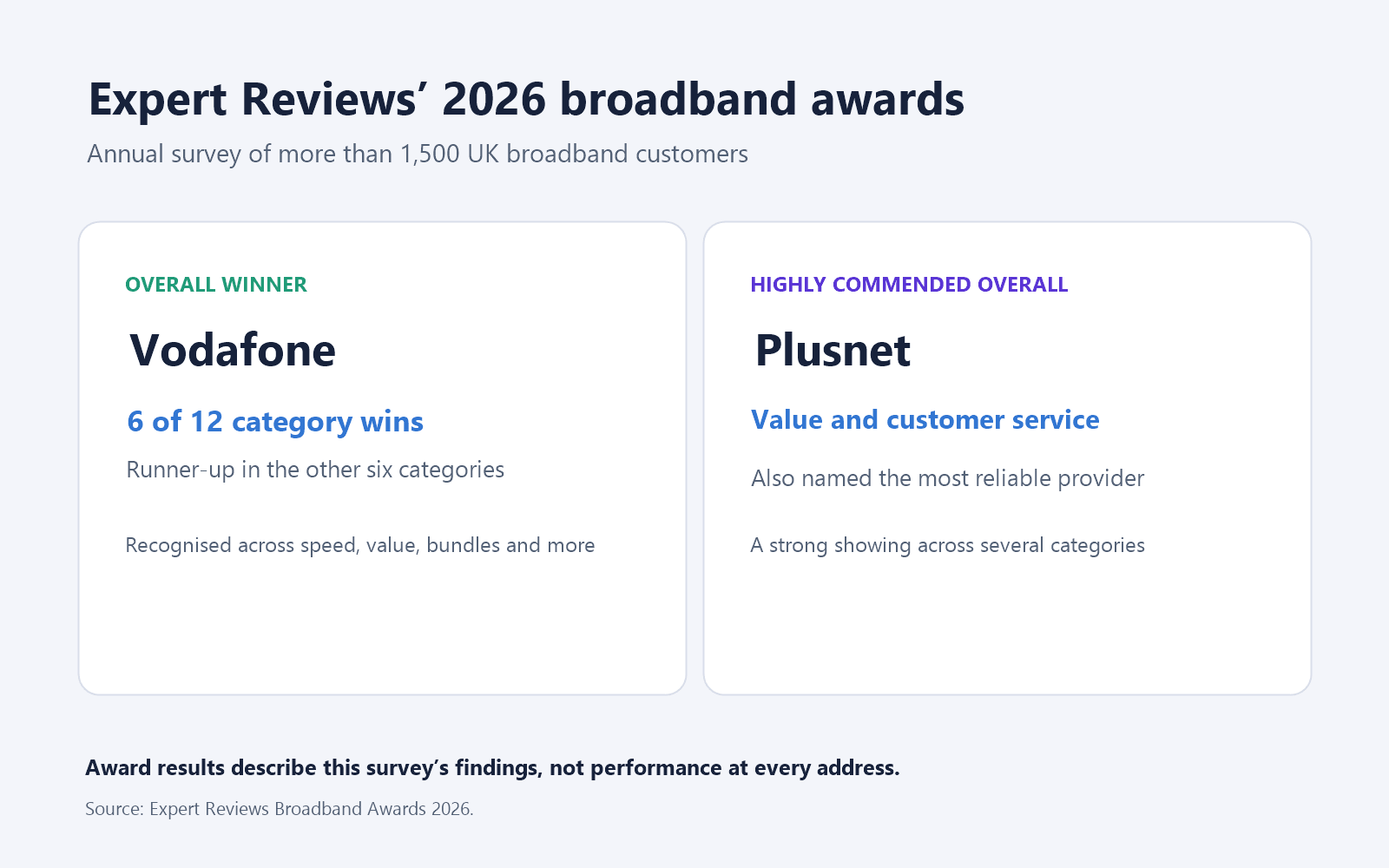
Expert Reviews named Vodafone its overall winner for the second year running, with Plusnet highly commended. Vodafone won six of the 12 award categories and finished runner-up in the other six. Plusnet won the value and customer-service categories and was named the most reliable provider.
The awards came from an annual survey of more than 1,500 UK residents. They show how respondents rated specific parts of their service. They do not guarantee performance on a particular network or at your address.
What does Ofcom’s 2024 report say about broadband customer service?
Ofcom’s detailed report is the most useful source here for understanding how providers performed across separate parts of customer service. It does not crown one winner. It shows where each provider did well and where customers or provider records point to problems.
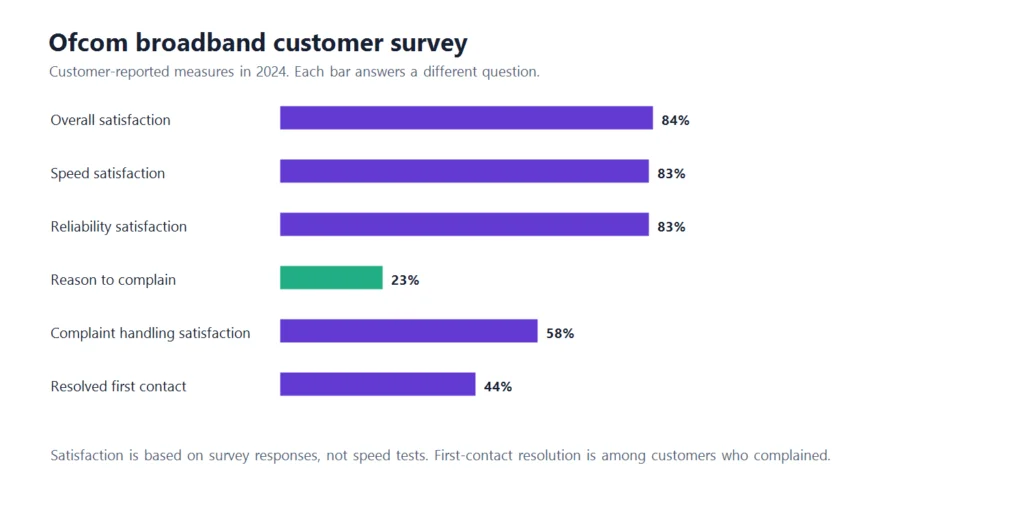
The customer survey part of the report found that 84% of broadband customers were satisfied with their service overall in 2024. Seven per cent were dissatisfied. Of those who were dissatisfied, 45% pointed to an unreliable connection and 30% said their speed was not what they expected.
Satisfaction with speed and reliability was 83% across broadband customers. These are customers’ views of their service, not measurements of the speed or reliability of each provider’s network. Ofcom’s results were based on 2024 experiences and compared with its previous survey wave in 2022.
Plusnet had the highest overall satisfaction in Ofcom’s provider results, at 91%. EE scored 87%, Vodafone 86%, BT 85%, Sky 84% and Virgin Media 83%. TalkTalk was below the industry average at 77%. Some smaller or lower-sample services were not shown because Ofcom had too few responses for a reliable provider-level result.
For speed satisfaction, Plusnet scored 84%, BT 85%, EE 86%, Sky 82%, Virgin Media 82%, Vodafone 87% and TalkTalk 75%. For perceived reliability, the scores were Plusnet 88%, BT 87%, EE 89%, Sky 84%, Virgin Media 80%, Vodafone 87% and TalkTalk 77%.
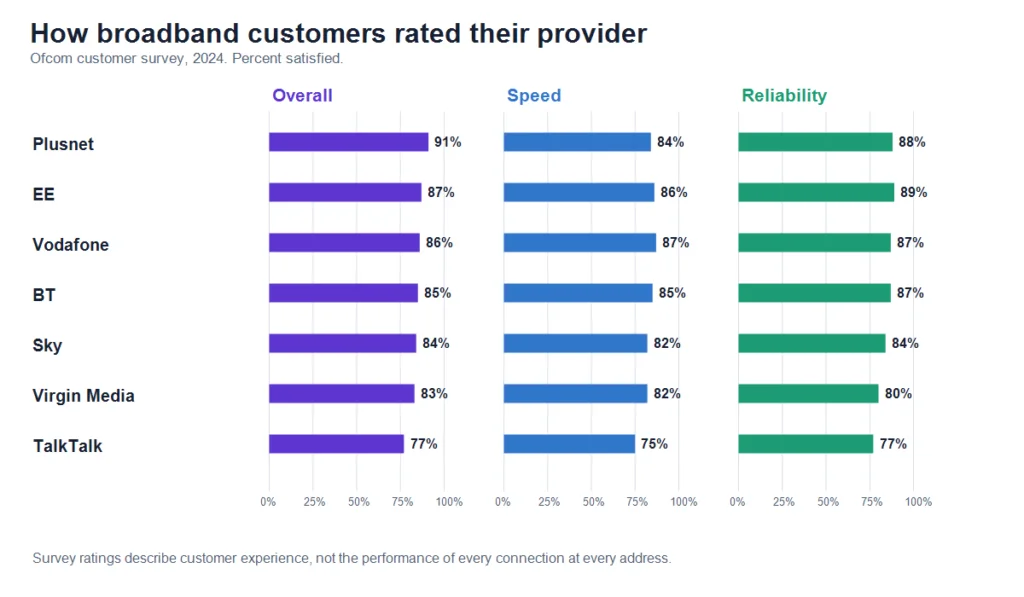
TalkTalk’s lower speed and reliability scores stand out. Virgin Media was also below the sector average for perceived reliability. These are signals worth weighing, but they do not tell you whether a particular connection at your address will be fast or stable. Your access network, home wiring, router position and Wi-Fi conditions can all affect what you experience.
Value for money is another useful measure. Ofcom found that 73% of standalone broadband customers were satisfied with value in 2024, up from 62% in 2022. This result is about customers’ views. It does not compare current package prices or the full cost over a contract.
How often do broadband customers have a reason to complain?
Ofcom found that 23% of broadband customers had a reason to complain in 2024, up from 20% in 2022. That does not mean all of them contacted their provider. Of the people who said they had a reason, 77% went on to make a complaint.
The most common causes were service problems such as slow speeds or an intermittent or total loss of service, named by 63% of those with a reason to complain. Billing, pricing or payment issues accounted for 26%, and dissatisfaction with customer service accounted for 14%. Respondents could identify more than one issue, so these percentages do not add up to 100%.
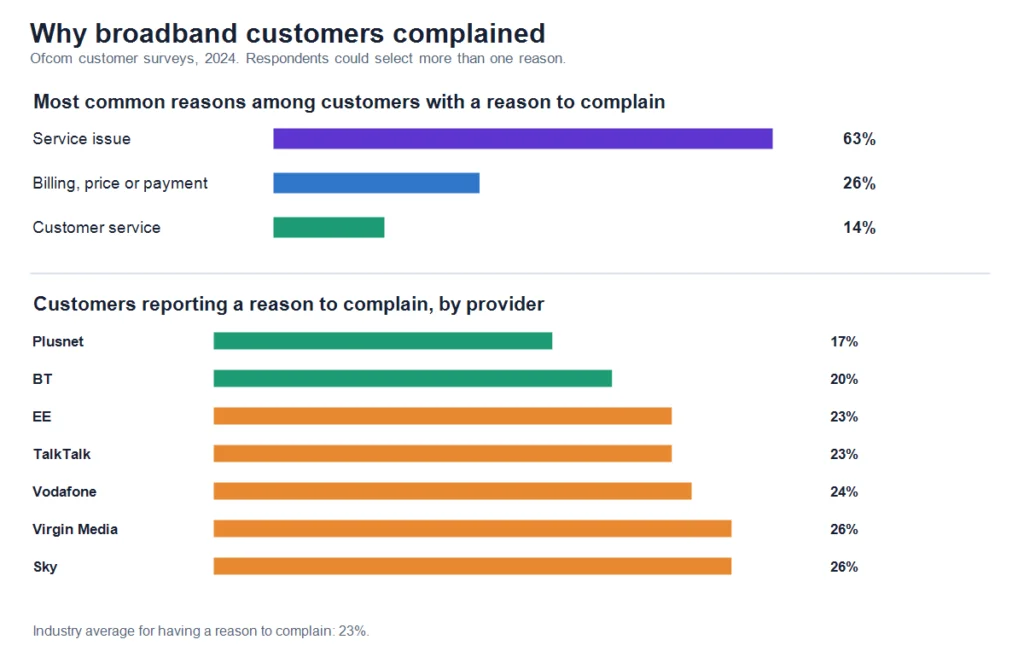
Virgin Media and Sky each had 26% of customers reporting a reason to complain. Vodafone was at 24%, EE and TalkTalk at 23%, BT at 20% and Plusnet at 17%. Plusnet and BT were below the sector average on this measure. Virgin Media and Sky were above it.
The figures make an important point. The number of people with a problem and the number who complain are not the same thing. Some people do not report their issue, and others may contact their provider without making a formal complaint.
How well do broadband providers handle complaints?
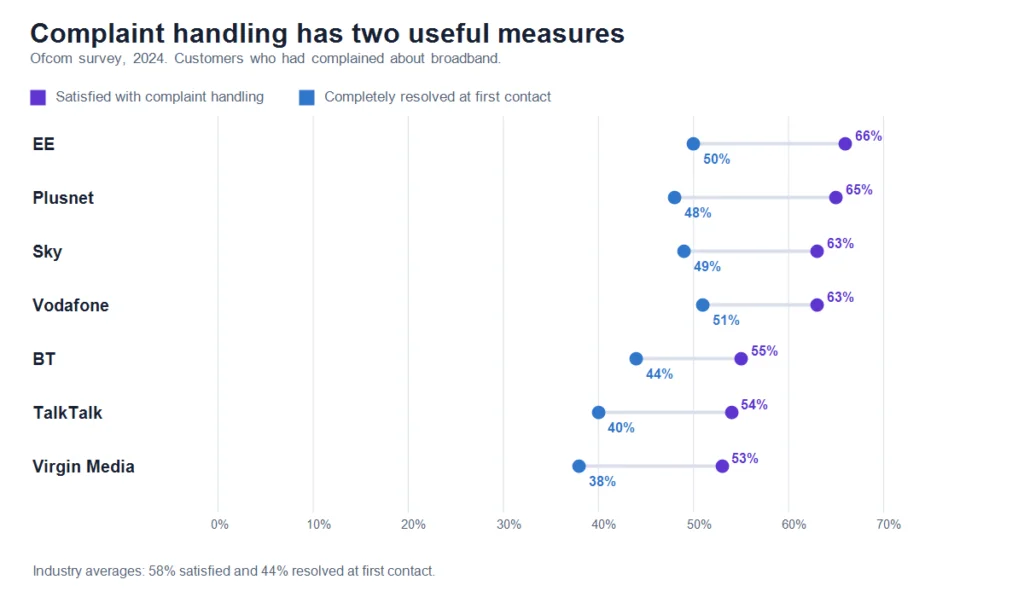
Ofcom asked customers who had complained about their broadband how they rated the way the provider handled it. In 2024, 58% were satisfied with complaint handling, up from 51% in 2022. Fourteen per cent were dissatisfied, unchanged from 2022.
EE had the highest satisfaction with complaint handling at 66%. Plusnet scored 65%, Sky 63%, Vodafone 63%, BT 55%, TalkTalk 54% and Virgin Media 53%. Ofcom found EE and Sky customers were less likely than average to be dissatisfied, while Virgin Media customers were more likely.
Satisfaction is only one side of the story. Ofcom also asked whether the complaint was completely resolved the first time the customer contacted the provider. The overall result rose from 39% in 2022 to 44% in 2024.
Vodafone resolved 51% of complaints at first contact, EE 50%, Sky 49%, Plusnet 48%, BT 44%, TalkTalk 40% and Virgin Media 38%. EE, Sky and Vodafone were above the sector average on this measure. TalkTalk and Virgin Media were below it.
A complaint resolved at first contact is a useful sign, but it does not tell you how long the customer spent getting help or whether the fix lasted. It is best read alongside customer satisfaction, call access and the fault data below.
How do broadband customers contact their provider?
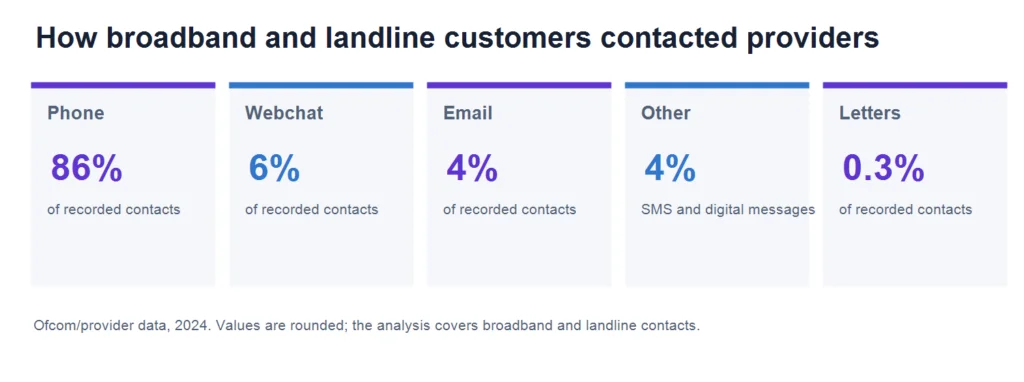
Ofcom’s provider-supplied contact data shows that phone calls remained the main way broadband and landline customers contacted providers in 2024. Phone calls made up 86% of recorded contacts, down from 88% in 2023. Webchat accounted for 6%, the same share as in 2023. Email made up 4%, up from 3%. Other channels also accounted for 4%, up from 3%, and included text messages and digital messaging services that providers could not classify more specifically. Letters made up 0.3% of contacts, compared with 0.2% in 2023. Ofcom warns that these shares are not directly comparable with older reports because the providers included in the analysis changed. One provider also could not separate some messaging-app contacts from webchat.
This matters because phone access remains central to customer support. If you prefer to solve problems by phone, call waiting and call abandonment may matter more to you than they would to someone happy to use webchat or an app.
These channel shares combine broadband and landline contacts. They show which routes customers used, not how quickly each provider answered an email or how useful a particular webchat session was.
How long do customers wait to speak to broadband support?
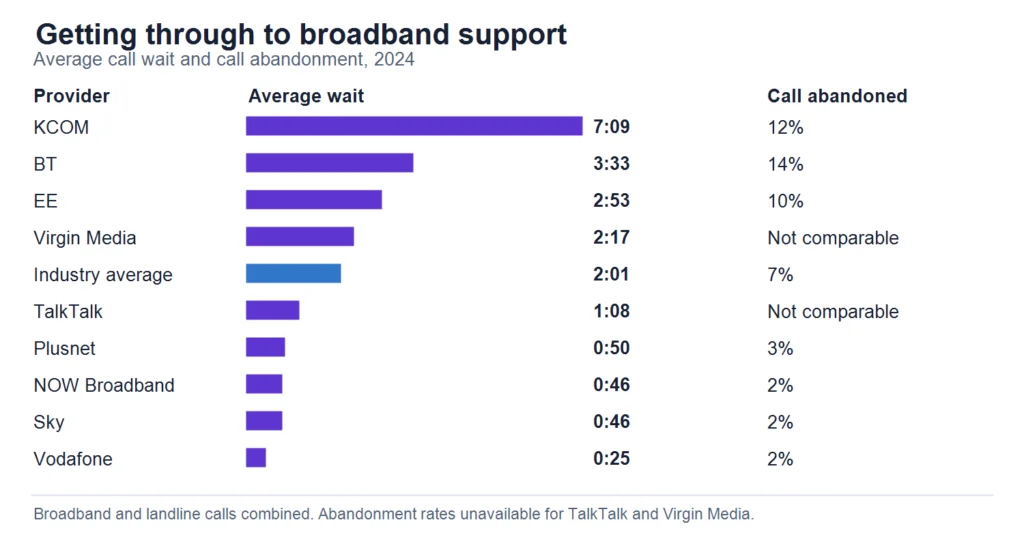
Ofcom reported an average call waiting time of 2 minutes and 1 second for broadband and landline providers in 2024, up from 1 minute and 48 seconds in 2023. The provider figures also combine broadband and landline calls.
Vodafone had the shortest average wait at 25 seconds. NOW Broadband and Sky averaged 46 seconds, Plusnet 50 seconds, TalkTalk 1 minute 8 seconds, Virgin Media 2 minutes 17 seconds, EE 2 minutes 53 seconds and BT 3 minutes 33 seconds. KCOM averaged 7 minutes 9 seconds.
The shortest waits look good on paper, but this is one annual provider-reported average. It does not show whether calls were made at peak times, why customers called or whether the adviser resolved the issue. It is still a practical measure if speaking to someone quickly is high on your list.
How many customers gave up before reaching an adviser?
A call abandonment is a call that ends before the customer speaks to an adviser. Ofcom’s 2024 industry average was 7%, up from 4% in 2023.
The provider figures were 14% for BT, 10% for EE, 12% for KCOM, 2% for NOW Broadband, 3% for Plusnet, 2% for Sky and 2% for Vodafone. Ofcom could not publish comparable 2024 rates for TalkTalk or Virgin Media, so those should not be treated as zero.
NOW Broadband, Sky and Vodafone had the lowest published abandonment rates at 2%. BT had the highest at 14%. This is a large gap, but it needs context. A customer may hang up because of a long queue, a disconnected call or a change of mind. The measure does not tell us which reason applied.
How are complaints to broadband providers different from complaints to Ofcom?
Ofcom’s customer survey asks people whether they had a reason to complain and whether they complained to their provider. Its separate complaint-handling survey asks people who had complained how they felt it was handled. A further dataset counts complaints that customers took directly to Ofcom.
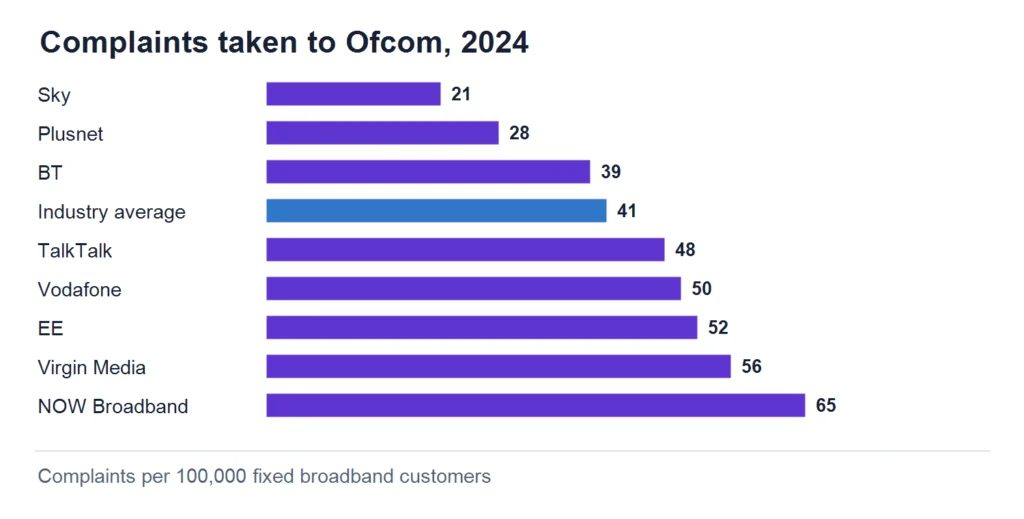
That last measure is not a count of every problem or every complaint made to the provider. Ofcom says it receives only a small proportion of consumer complaints. It publishes the results per 100,000 customers so providers of different sizes can be compared more fairly.
In the detailed annual 2024 report, Sky had 21 Ofcom complaints per 100,000 fixed broadband customers. Plusnet had 28, BT 39, the industry average was 41, TalkTalk 48, Vodafone 50, EE 52, Virgin Media 56 and NOW Broadband 65.
Ofcom’s latest quarterly update covers April to June 2026. Virgin Media recorded 4 complaints per 100,000 broadband customers. Plusnet and Sky each recorded 5, against an industry average of 6. BT, EE, TalkTalk and Vodafone each recorded 7.
Ofcom says small differences of less than one complaint per 100,000 are comparable. It therefore groups Virgin Media, Sky and Plusnet as the lowest-complaint providers, Plusnet and the industry average as another comparable pair, and BT, EE, TalkTalk and Vodafone together in a higher-complaint group. The figures are rounded, so do not treat 4, 5 and 6 as a precise first, second and third place ranking.
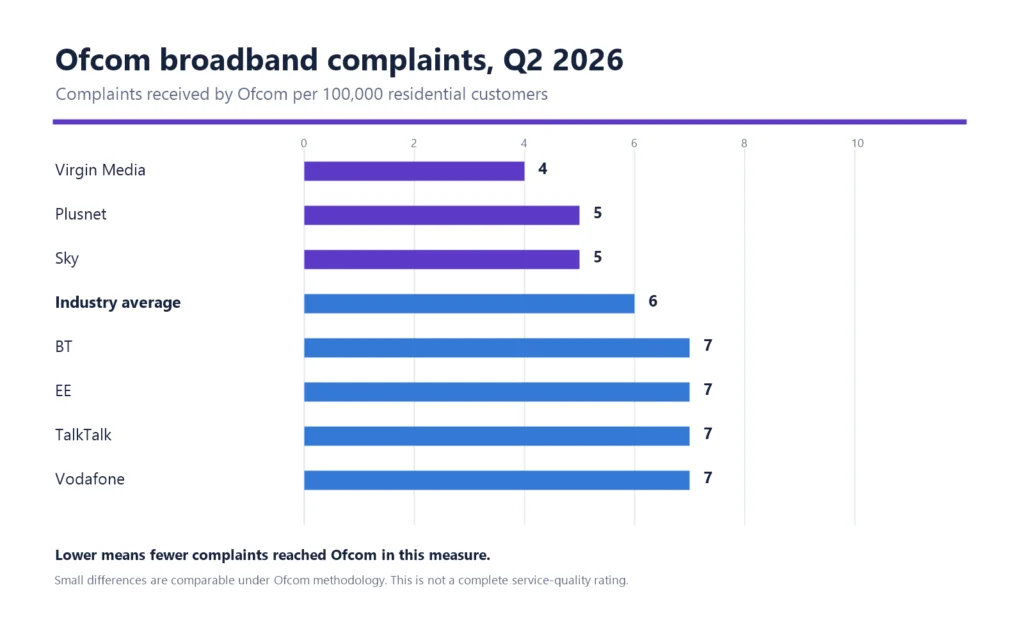
The biggest drivers in the latest quarter were faults, service quality and problems getting a service connected. Ofcom’s complaint data is useful for identifying patterns, but it cannot tell you whether a provider will perform well on your line or resolve your personal fault quickly.
How do providers compare on broadband faults and repairs?
Ofcom also collected information directly from providers about faults and service delivery. These figures are separate from customer survey scores and complaints people took to Ofcom.
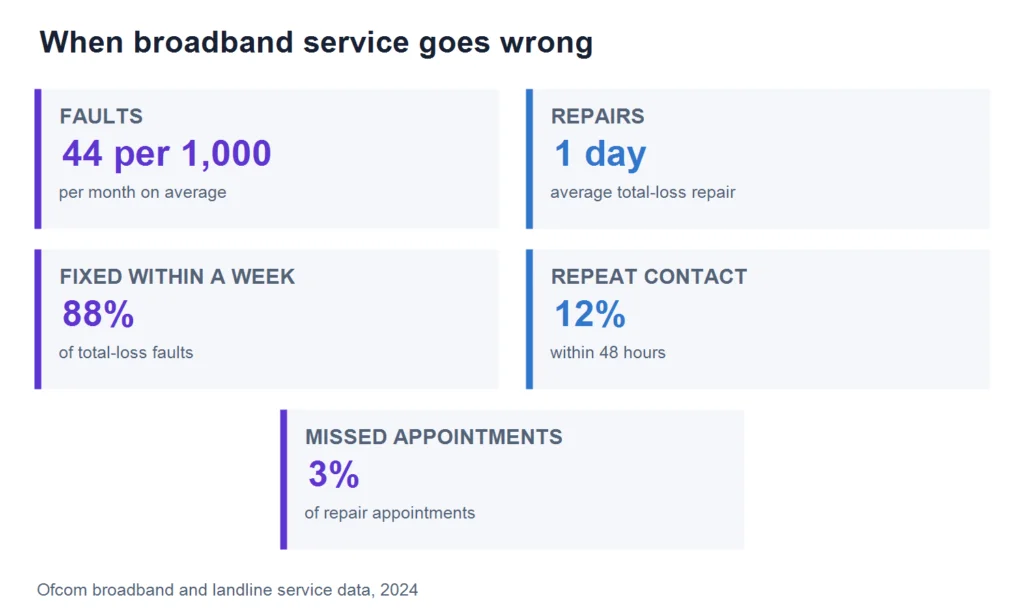
Across the providers in the report, there were 44 broadband and landline faults per 1,000 customers per month in 2024, down from 47 in 2023. The provider figures were BT 51, EE 51, KCOM 16, NOW Broadband 19, Sky 27, TalkTalk 47, Virgin Media 51 and Vodafone 56 faults per 1,000 customers per month. Plusnet did not provide a comparable 2024 total. KCOM recorded the lowest rate and Vodafone the highest. EE was the only provider whose fault rate increased compared with 2023.
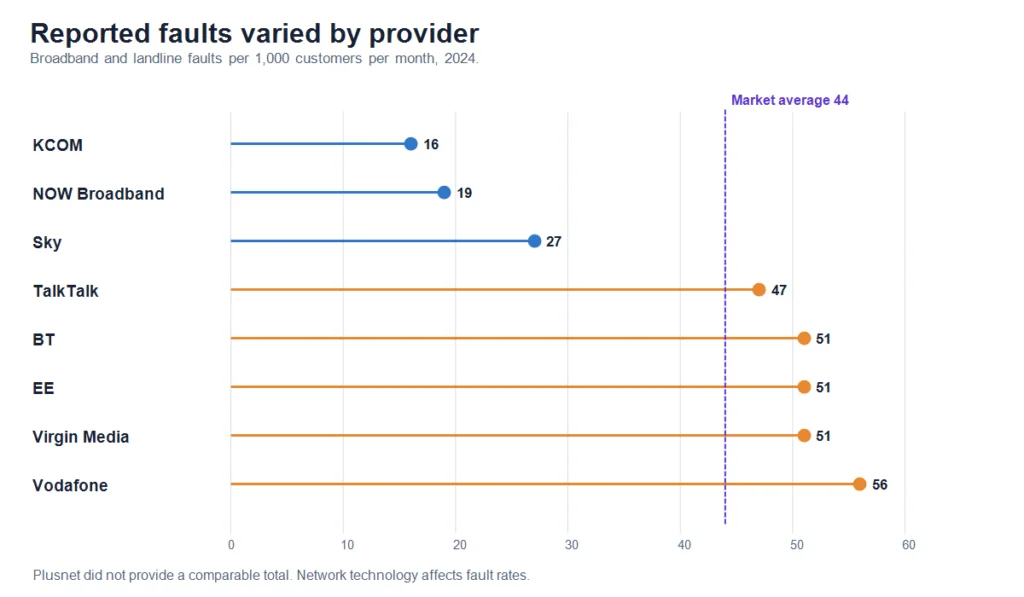
Ofcom cautions that network technology affects fault rates. Providers with more copper connections may record more faults than providers with more full-fibre connections. Virgin Media’s cable network had fault rates similar to, though marginally higher than, its full-fibre connections in Ofcom’s analysis.
For a total loss of service, providers took an average of one day to repair the fault. Provider averages were BT one day, EE six, KCOM two, NOW Broadband two, Plusnet three, Sky one, TalkTalk three, Virgin Media same day and Vodafone one day. Across all providers, 88% of total-loss faults were repaired within a week. Virgin Media repaired 99% within a week. EE repaired 56% within a week, and 28% of its total-loss faults took more than three weeks.
The share of repeat contacts within 48 hours of a total-loss fault rose to 12%. The provider rates were BT 18%, EE 39%, KCOM 3%, NOW Broadband 3%, Plusnet 2%, Sky 5%, TalkTalk 12%, Virgin Media 3% and Vodafone 5%. These figures show how often customers contacted the provider again soon after a total-loss fault. They do not explain why each customer got back in touch.
How quickly are new connections completed, and are appointments kept?
Across all order types, providers took an average of 11 days to complete an order in 2024. The provider averages were BT 11 days, EE 12, KCOM 9, NOW Broadband 13, Plusnet 12, Sky 14, TalkTalk 16, Virgin Media 4 and Vodafone 18. This measure includes different kinds of service orders, so it is not the same as a promise about a new installation.
A switch to a new provider took an average of 14 days. Virgin Media averaged 8 days, while KCOM averaged 19. A change to an existing service took 5 days on average, ranging from no reported delay for Virgin Media to 20 days for both TalkTalk and Vodafone. A home move with the same provider took 13 days on average. These are different jobs, so the figures should not be treated as one provider league table.
For a new full-fibre service, the average completion time was 14 days. The provider averages were BT 11 days, EE 14, KCOM 10, Plusnet 15, Sky 15, TalkTalk 17, Virgin Media 13 and Vodafone 19. Ofcom had no comparable figure for NOW Broadband. The time required still depends on what work is needed at the property.
Providers completed 73% of all orders by the date agreed with the customer. The provider results were BT 69%, EE 69%, KCOM 86%, NOW Broadband 91%, Plusnet 87%, Sky 95%, TalkTalk 93%, Virgin Media 79% and Vodafone 60%.
Three per cent of appointments were missed overall. The provider rates were BT 1%, EE 1%, KCOM 1%, NOW Broadband 2%, Plusnet 2%, Sky 5%, TalkTalk 3%, Virgin Media 1% and Vodafone 2%. Looking only at repair visits, the average missed rate was also 3%, with Sky at 8% and EE and Virgin Media at 1%. For a home move with the same provider, Ofcom recorded 14 days for BT and EE, 8 for KCOM, 11 for NOW Broadband, 16 for Plusnet, 14 for Sky, 13 for TalkTalk and 9 for Virgin Media. Vodafone had no comparable figure for this measure.
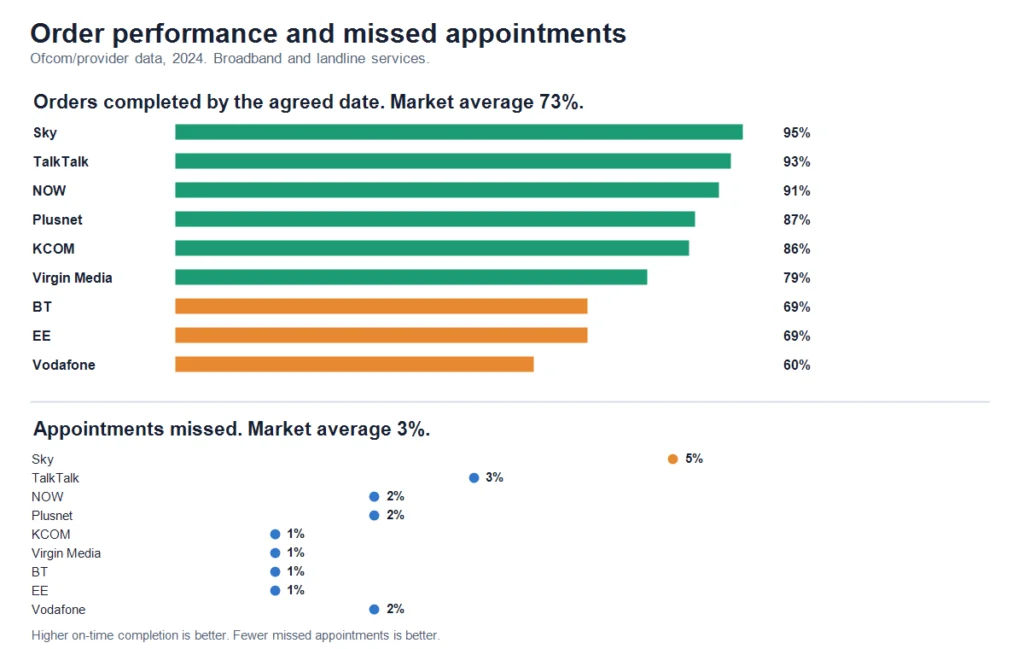
These measures help show how the process can feel after you sign up, not just how the connection performs once it is running. The report’s provisioning and repair sample does not include every provider, and its appointment data is not the same as the automatic compensation dataset.
When does automatic broadband compensation apply?
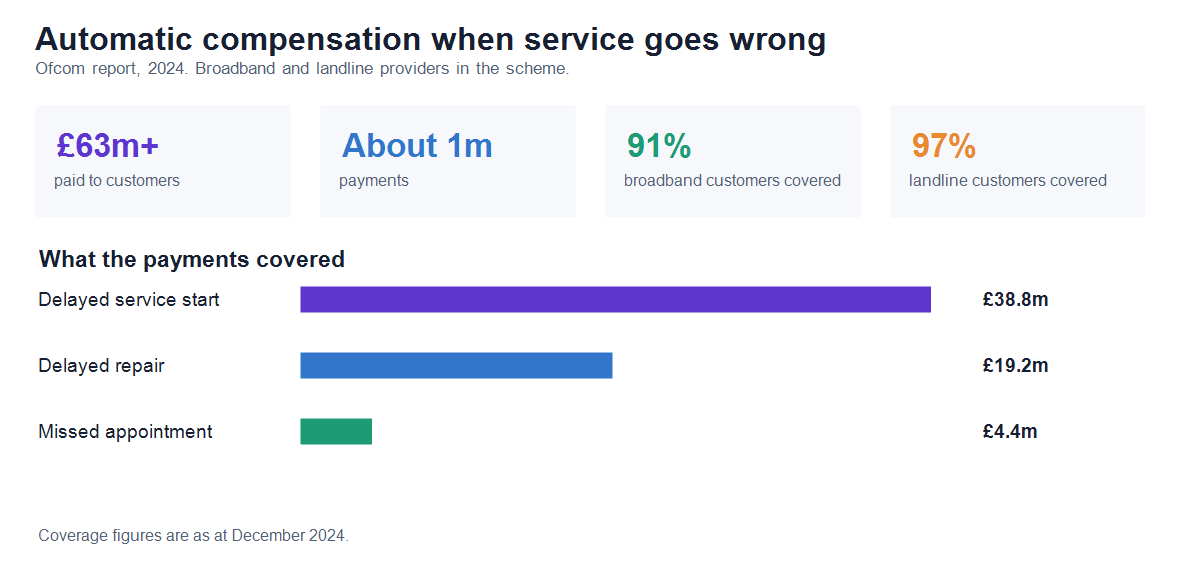
Automatic compensation is money a participating provider must pay when a qualifying service problem meets the scheme’s conditions. It covers delayed starts to a new service, missed engineer appointments and delayed repairs after a total loss of service. The provider should apply it automatically when the rules are met.
At the end of 2024, the scheme covered providers serving 91% of broadband customers and 97% of landline customers. Participating broadband brands included BT, EE, Hyperoptic, Plusnet, Sky, TalkTalk, Utility Warehouse, Virgin Media, Vodafone and Zen. Some network or service arrangements have exclusions, so a customer should check the terms that apply to their service.
Ofcom reported that providers paid more than £63 million in automatic compensation in 2024, across about one million payments. Delayed starts to new services accounted for the largest share of the money, at £38.8 million. Delayed repairs after a total loss of service accounted for £19.2 million, and missed appointments £4.4 million.
The total amount paid fell from more than £67 million in 2023. Ofcom also noted a reporting shortfall in BT Group’s 2024 data because of two issues with automatic payments affecting BT, EE and Plusnet. The figures show the scheme in action across the market, but they are not a provider-by-provider customer-service rating.
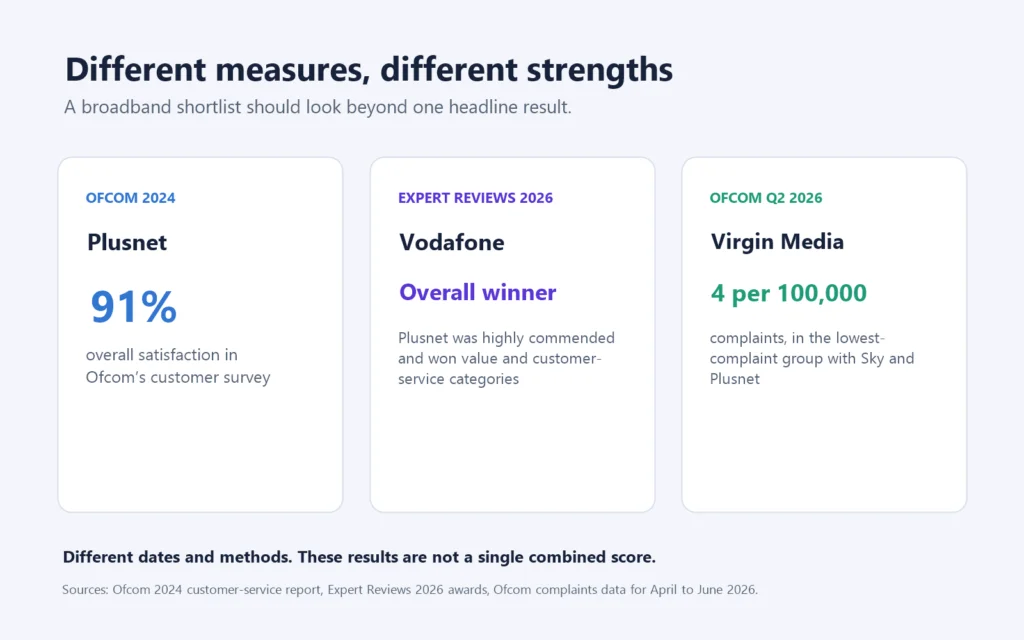
Ofcom and Expert Reviews provide useful but different evidence. The next section looks at how those findings apply to individual providers and what still depends on your address.
How do individual broadband providers compare?
Plusnet
Plusnet is my strongest all-round shortlist choice in this evidence set. In Ofcom’s 2024 report, it had the highest overall satisfaction at 91%, the lowest share with a reason to complain at 17%, and 65% satisfaction with complaint handling. Its first-contact resolution rate was 48%, above Ofcom’s 44% average. It also had 28 Ofcom complaints per 100,000 customers in 2024 and was in the lowest-complaint group in Q2 2026.
Plusnet came highly commended overall in Expert Reviews’ 2026 survey and won its value and customer-service categories. It was also named the most reliable provider in that survey. That mix makes it a convincing all-round option, but it does not make Plusnet the automatic choice for every address or budget. See our Plusnet broadband review and deals.
Zen Internet
Zen is a smaller independent provider, and the sources used here do not offer a directly comparable provider score for every part of its service. Missing figures should not be treated as a poor result. Check Zen’s current packages, contract terms and availability at your address before shortlisting it.
Zen did not meet Expert Reviews’ minimum response threshold for its 2026 provider rankings. Ofcom also did not publish several Zen survey measures because the response base was below its threshold. That leaves less directly comparable evidence in these reports, so check Zen’s current packages, availability and other independent reviews before deciding.
Vodafone
Vodafone won Expert Reviews’ 2026 overall award and was highly rated in its speed and value categories. Ofcom’s 2024 data gives a more mixed service picture. Vodafone had a 24% reason-to-complain rate, 63% complaint-handling satisfaction and a 51% first-contact resolution rate, the highest reported among the providers in that report. Its average call wait was the shortest at 25 seconds.
However, Vodafone had 50 Ofcom complaints per 100,000 customers in 2024 and the highest recorded monthly fault rate in Ofcom’s provider data, at 56 per 1,000 customers. These results come from different measures, and Ofcom cautions that network mix affects fault rates. Vodafone can be a strong candidate, especially where its price and full-fibre packages fit, but its award should not make you skip the service evidence. See our Vodafone broadband review and deals.
Sky
Sky’s latest quarterly complaints result is one of the better ones, and it had the lowest annual Ofcom broadband complaints rate in 2024 at 21 per 100,000 customers. Ofcom’s 2024 survey gave Sky 84% overall satisfaction, 63% complaint-handling satisfaction and a 49% first-contact resolution rate. Its average call wait was 46 seconds, with a 2% call abandonment rate.
These results are mixed rather than uniformly strong or weak. Check the package, the available network and the kind of service issue you most want to avoid. See our Sky broadband review and deals.
Virgin Media
Virgin Media was in Ofcom’s lowest-complaint group in Q2 2026, at 4 complaints per 100,000 customers. That is a marked improvement on its annual 2024 figure of 56 per 100,000, though the quarterly and annual periods should remain separate.
Ofcom’s 2024 customer survey gave Virgin Media 83% overall satisfaction, 82% speed satisfaction and 80% reliability satisfaction. Its complaint-handling score was 53%, and 38% of complaints were resolved at first contact. Ofcom’s provider data also recorded the same-day average repair for total loss of service and 99% of these faults repaired within a week.
Those figures describe different parts of the experience and do not cancel each other out. Ofcom’s survey and operational measures cover different periods and questions. Check local availability and think about whether speed, reliability, support or price matters most to you. See our Virgin Media broadband deals.
BT and EE
BT’s Ofcom scores were mixed. Its 2024 customer satisfaction was 85%, with 55% satisfaction for complaint handling and 44% of complaints resolved at first contact. The average phone wait was 3 minutes 33 seconds, and 14% of calls were abandoned before an adviser answered. Its quarterly complaint result in Q2 2026 was in Ofcom’s higher-complaint group.
EE had 87% overall satisfaction and 66% satisfaction with complaint handling in Ofcom’s 2024 survey. Half of its complaints were resolved at first contact. But its average call wait was 2 minutes 53 seconds, 10% of calls were abandoned, and Ofcom recorded a six-day average to repair a total loss of service. EE also had a 39% repeat-contact rate within 48 hours after such faults.
Those numbers point to strong complaint-handling satisfaction alongside weaker phone access and repair indicators. If you are comparing the two brands, look at the actual package, network and support options offered at your address. See our BT broadband deals and EE broadband review and deals.
TalkTalk and NOW Broadband
TalkTalk had lower Ofcom satisfaction with its overall service, speed and reliability than the industry averages in 2024. Its scores were 77% overall satisfaction, 75% for speed and 77% for reliability. It had 54% complaint-handling satisfaction and a 40% first-contact resolution rate. Its 2024 Ofcom complaint rate was 48 per 100,000 customers.
NOW Broadband had the highest annual Ofcom complaint rate in the 2024 detailed report, at 65 per 100,000 customers. It also had the lowest published call-abandonment rate at 2% and an average wait of 46 seconds. Some Ofcom survey scores were unavailable because there were not enough respondents to publish a provider result. Read these as separate clues about different parts of the service.
These measures show why a single statistic can mislead. One describes complaints taken to Ofcom, another records calls ending before an adviser answers and another reflects customer survey answers. Read them as separate clues, not as contradictions.
Hyperoptic and Community Fibre
Regional and full-fibre providers can be strong options where their networks reach, but the sources used here do not publish a directly comparable score for every provider. Their coverage is more limited than the largest brands, so an address check matters before comparing packages.
Community Fibre was not included in Ofcom’s provider comparisons in the same way as the larger brands. Do not treat missing provider-level figures as a poor result. It means the source does not give a direct measure for that provider. See available Community Fibre packages where its network reaches your home.
Which broadband providers and deals are available at your address?
UK-wide survey results help you choose what to look at. Your address determines which providers and packages are actually available. Enter your postcode below to see the broadband deals offered at your address. If a provider is not available there, the checker will show the alternatives it can find.
Compare broadband providers and deals available at your address
Enter your postcode to see the providers and packages you can order at home.
How to choose the best broadband provider for you
Start with availability, then compare the package rather than choosing on brand name alone.
- Check the speed you can order at your address. Pick a package that suits the number of people and devices in your home. A higher speed is not automatically worth paying more for.
- Compare the total cost over the full contract. Include the monthly charges, setup fees, equipment costs and any optional extras you want.
- Check the connection type. Full fibre, cable and part-fibre services use different networks and can perform differently.
- Decide what kind of support matters to you. If you prefer to speak to an adviser, compare call waits and abandonment rates. If you are happy with digital support, check the provider’s available contact options.
- Look at reliability evidence that matches your concern. Customer surveys show reported experience, while provider fault data measures recorded faults across their networks.
- Check the contract end date and terms before switching or renewing. A low introductory cost may not be the lowest full-contract cost.
If you want to compare current packages, begin with the providers returned for your postcode, then use Ofcom and survey results to narrow that list. The provider with the highest UK-wide score may not be the best option on your street.
So, who is the best broadband provider in the UK?
If I had to choose one provider for an all-round shortlist, I would start with Plusnet. It scored well across several Ofcom customer measures and came second in Expert Reviews’ 2026 survey. That is a more convincing case than relying on one award or one complaints figure.
Vodafone leads Expert Reviews’ overall awards, while Plusnet performed strongly across the Ofcom measures and Expert Reviews categories. Virgin Media, Sky and Plusnet are grouped among Ofcom’s lowest-complaint providers in the latest quarter.
My recommendation is clear, but it is not a universal verdict. Check which providers serve your address, compare the full package cost and use the evidence that matches what you value. Availability and a suitable package come first. Awards come after that.
Frequently asked questions
Who was named the best broadband provider in the 2026 survey?
There is no single customer score shared across all providers. Expert Reviews named Vodafone its 2026 overall winner in an annual survey of more than 1,500 UK residents. Plusnet was highly commended overall and won several categories.
Which provider has the fewest broadband complaints?
In Ofcom’s April to June 2026 figures, Virgin Media recorded 4 complaints per 100,000 customers. Sky and Plusnet each recorded 5. Ofcom groups Virgin Media, Sky and Plusnet among the lowest-complaint providers because small differences are treated as comparable.
Is Plusnet the best broadband provider?
Plusnet is my strongest all-round shortlist choice in the evidence reviewed here. It performed well across Ofcom’s 2024 service measures and came second in Expert Reviews’ 2026 survey. Check its availability and current package terms before deciding.
Which broadband provider has the best customer service?
There is no single measure of customer service. In Ofcom’s 2024 report, EE had the highest complaint-handling satisfaction at 66%, Vodafone had the highest first-contact resolution rate at 51%, and Vodafone also had the shortest average call wait at 25 seconds. Each result measures something different.
Are smaller broadband providers better?
Some smaller providers may suit customers particularly well, but broad, directly comparable data is not available for every provider. Their coverage is more limited, so check whether they serve your address before comparing packages, prices and contract terms.
How do I find the best broadband deal in my area?
Enter your postcode in the checker above. Compare the packages available at your address, including speed, total contract cost, contract length and any service evidence that matters to you.
Sources