
Average broadband cost in the UK. How much should you pay?
Ofcom’s latest published operator data puts standalone broadband spending at £31.05 a month. Uswitch’s August 2026 average advertised prices for fixed broadband offers ranged from £28.41 to £29.48. Those figures measure different things, so your contract, bundle and address matter too.
The key numbers behind broadband bills
- Ofcom’s Q2 2025 data puts average standalone broadband spend at £31.05 a month.
- Uswitch’s August 2026 average starting prices for fixed broadband ranged from £28.41 to £29.48 a month.
- Ofcom found that standalone broadband customers out of contract paid about £7 more a month than those still in contract.
- A broadband bill that includes a landline, TV or mobile service will be higher than a broadband-only figure.
What is the average broadband cost in the UK?
Ofcom’s latest published customer-spend data puts standalone fixed broadband at £31.05 a month in Q2 2025. Broadband with a landline averaged £39.20 a month. Ofcom collected the figures from BT, including EE and Plusnet, KCOM, Sky, TalkTalk, Three, Virgin Media O2 and Vodafone.
These are average amounts customers paid. They aren’t the prices advertised to people signing up to a new deal, and the provider sample doesn’t include every UK broadband company.
Uswitch’s latest published price comparison covers offers listed in August 2026. Its average initial monthly prices were £29.48 for part-fibre, £28.41 for full fibre, £29.08 for Virgin Media cable and £16.15 for mobile broadband. They’re averages of advertised products on Uswitch before any scheduled price changes.
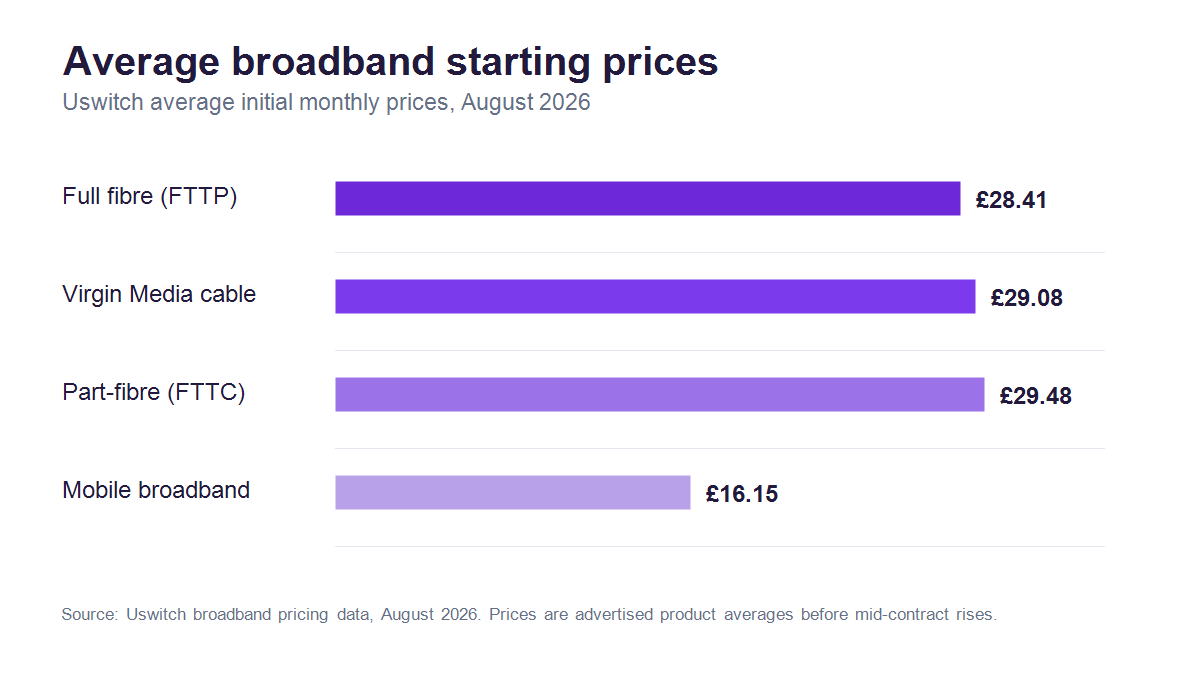
The two sets of figures answer different questions. Ofcom measured customer bills across several large providers. Uswitch averaged the opening prices of products listed on its comparison site. Neither one tells you what a particular provider will charge at your address.
Why can broadband bundles cost more?
If your bill includes a phone line, pay TV or a mobile service, the broadband-only average won’t match it. Ofcom’s Q2 2025 data puts average monthly spend at £31 for standalone broadband, £39 for broadband with a fixed voice line, £53 for broadband with pay TV and £59 for broadband with a mobile phone. Households taking several services together spent more on average.
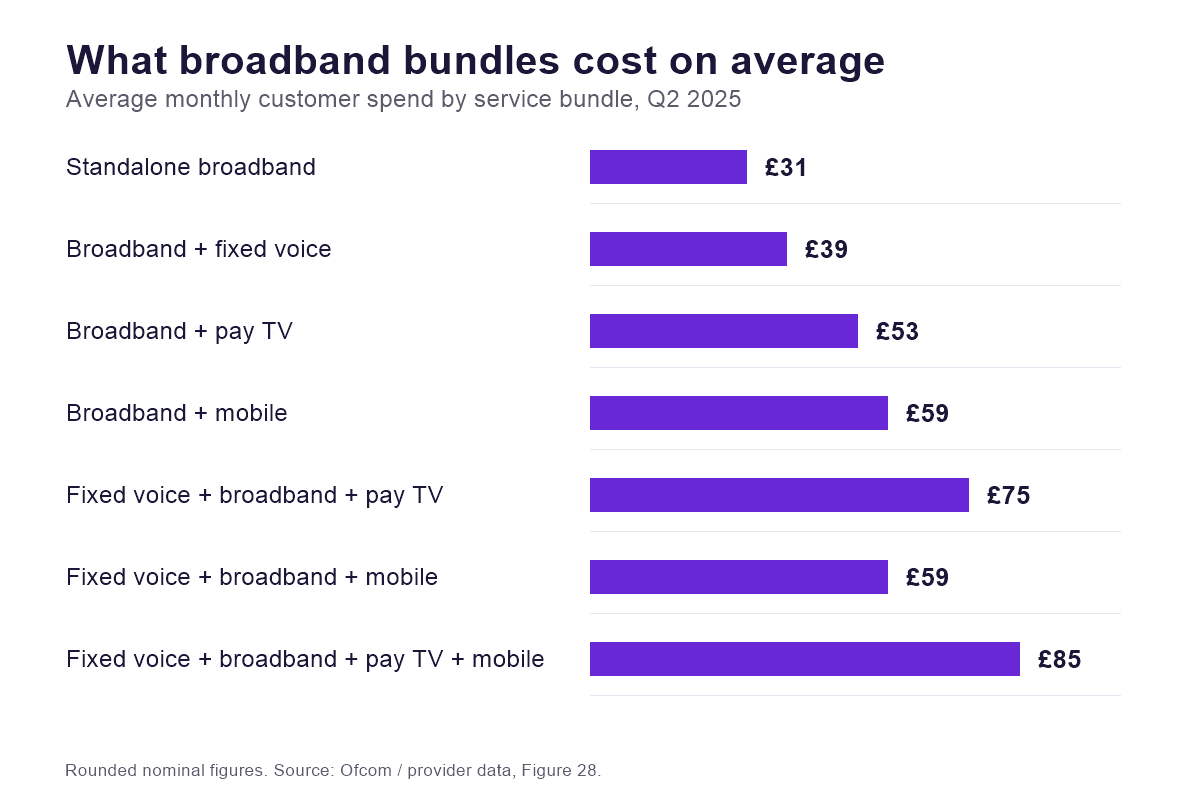
That’s why a £39 or £59 bill isn’t directly comparable with the £31 standalone figure. Check what else is included before judging the price. If you don’t use the landline or TV service, see what broadband-only packages are available.
Do out-of-contract customers pay more?
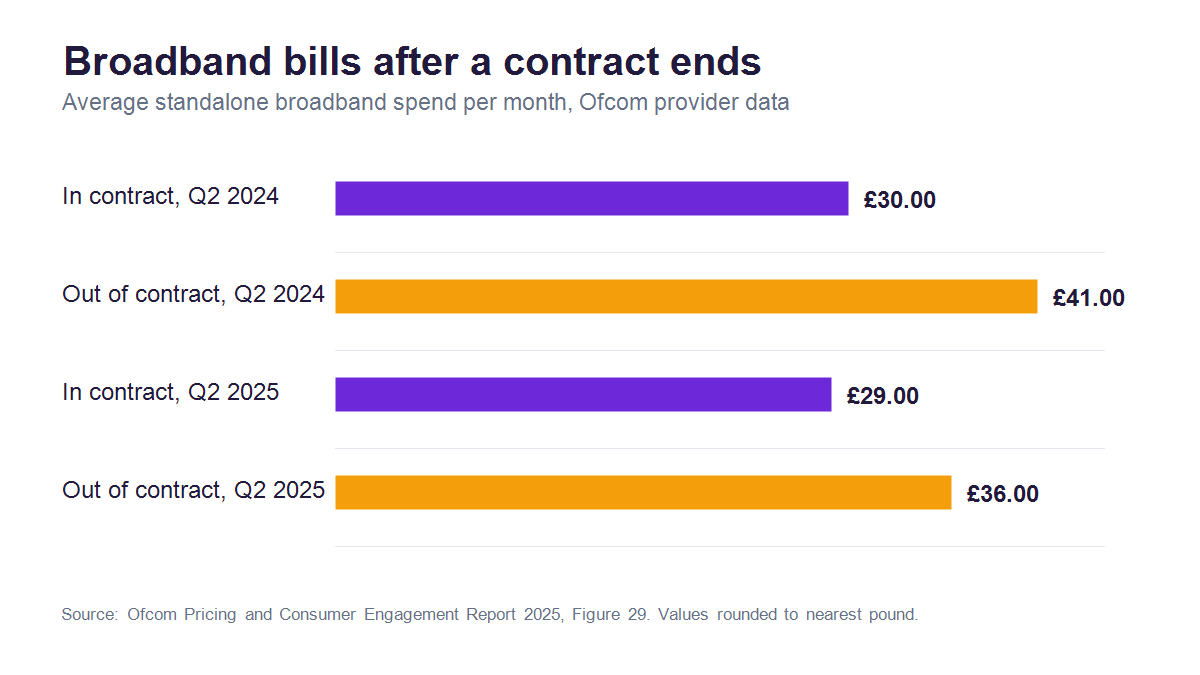
Ofcom’s 2025 report puts average standalone broadband spend at £29 a month for customers still in contract and £36 for customers whose contract had ended. That’s a gap of about £7 a month. In 2024, the equivalent rounded averages were £30 and £41.
The gap is an average across Ofcom’s provider data, not a fixed increase applied to every customer. Still, if your minimum term has ended, check the amount you’re paying and compare it with current offers.
Why do broadband prices vary by area?
The national average can’t show which networks and packages are available in your area. Ofcom’s January 2026 data shows full fibre coverage at 81% of UK premises. It was 83.4% in the City of Bristol local authority, 96.7% in Coventry, 87% in Cardiff and 48.5% in Aberdeenshire.
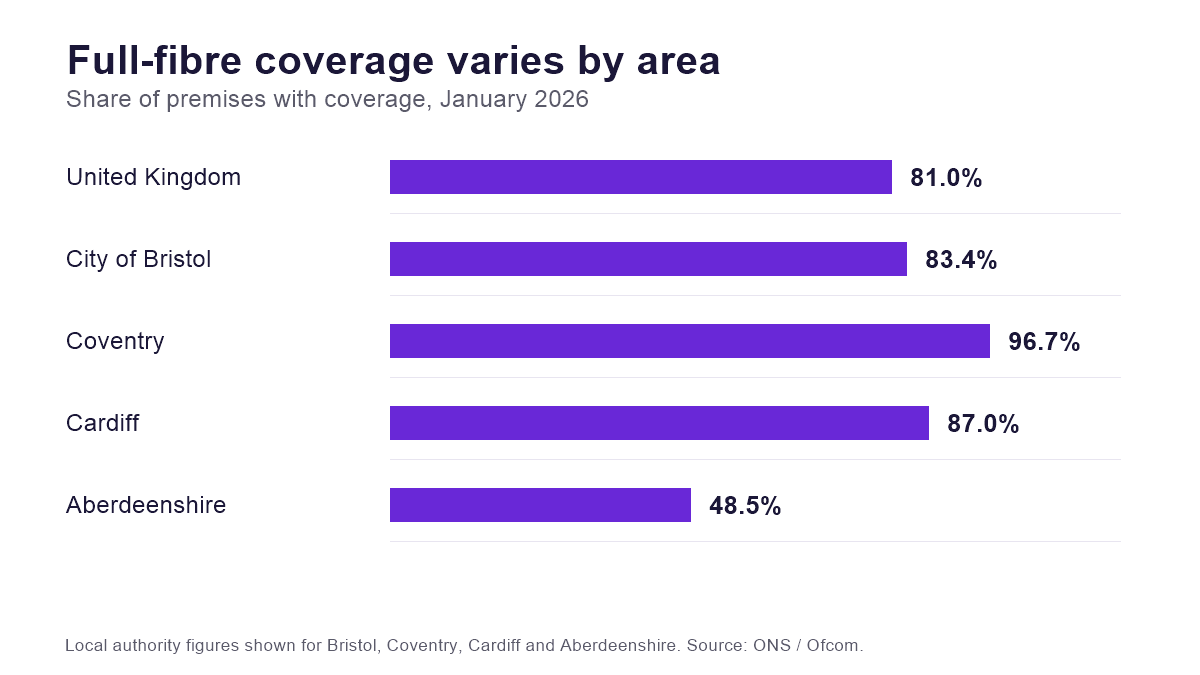
Those figures describe area coverage, not local broadband prices or service at an individual property. They do show why the offers you can compare may differ between places. Check the providers available at your address before choosing a package.
Check broadband deals available at your address
Enter your postcode to see which providers can connect your home and compare their current deals.
How does the UK compare with Europe and the US?
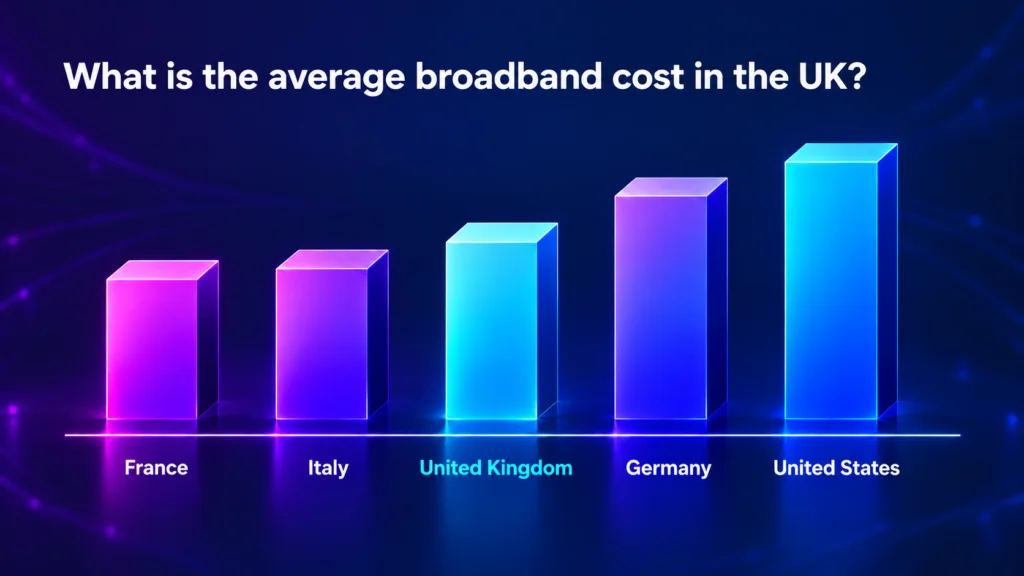
For a closer international comparison, look at broadband offers in the same speed range. A 2025 study commissioned by Canada’s Innovation, Science and Economic Development department compared fixed broadband service baskets across the UK, the United States, France, Germany, Italy and other markets.
For plans offering at least 500Mbps, its weighted monthly averages convert to about £31.10 for the UK, £24.34 for France, £26.22 for Italy, £41.36 for Germany and £45.37 for the United States. The converted US figure is about £14.27, or 46%, higher than the UK’s. France and Italy were lower, while Germany was higher.
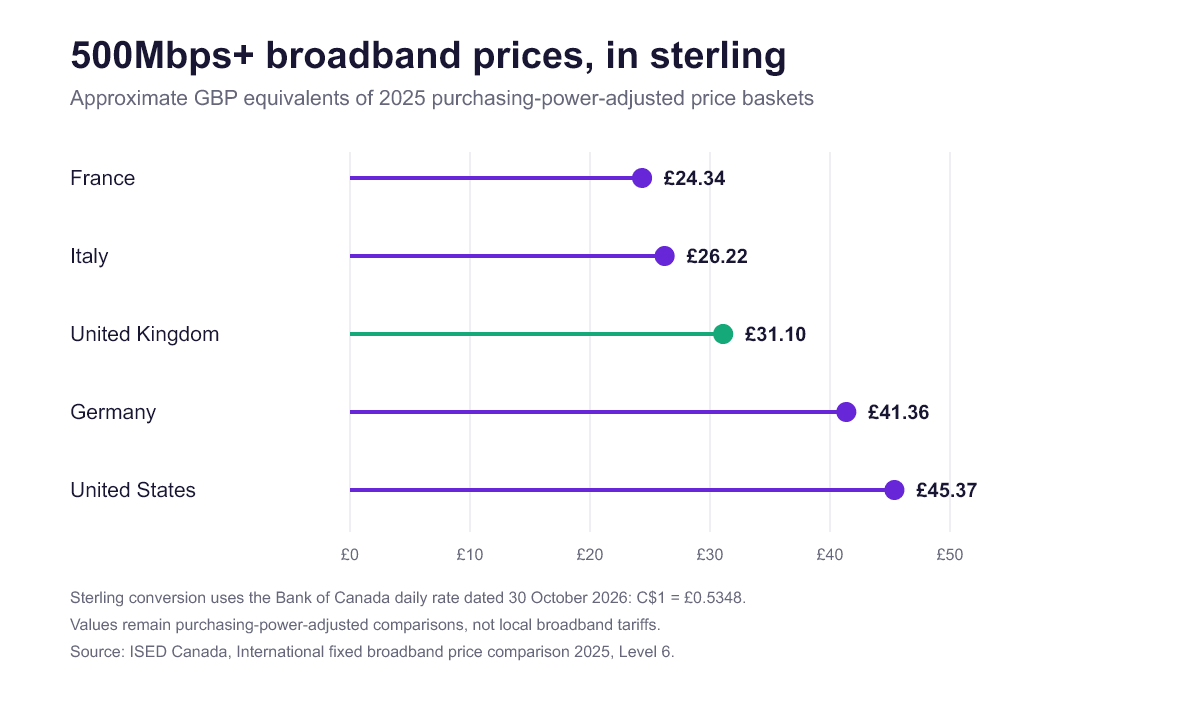
This isn’t the same measure as Ofcom’s £31.05 average. Ofcom reports what customers spent on standalone broadband in the UK. The international study compares selected advertised plans in a 500Mbps-plus speed basket. It first adjusts prices for purchasing power, then the figures above convert those comparison values into sterling using the dated rate below. They aren’t local tariffs or typical household bills.
The country samples are also limited. The UK figures use London, while the US sample covers Boston, Kansas City, Minneapolis and Seattle. France, Germany and Italy use Paris, Berlin and Rome. Where standalone broadband wasn’t available, the study used a broadband bundle. It’s a useful speed-basket comparison, not a full average for every European country or every address.
How can you tell if your broadband is good value?
Start with the service you’re paying for. If your bill includes TV, mobile or a landline, separate those costs where you can. Then check the details that affect what you’ll pay over the full contract.
- Check whether you’re still in your minimum term and when it ends.
- Add the monthly payments, setup charges and scheduled price changes across the contract.
- Choose a speed that fits your household. Paying for a faster tier won’t fix weak Wi-Fi or a device that can’t use the extra speed.
- Compare deals that are available at your address, not just the cheapest national headline offer.
- If you or someone in your household receives a qualifying benefit, check whether you can get a social tariff.
For contracts agreed from 17 January 2025, providers must set out any scheduled in-contract price rise in pounds and pence before you sign. Older contracts may still have different terms. Ofcom explains how the rules work.
How do you work out the full broadband contract cost?
Add every monthly payment, setup charge and scheduled rise. Then divide the total by the number of months in the minimum term. This gives you an effective monthly cost to compare with another offer.
For example, a 24-month deal at £18 a month for six months and £30 for the next 18 months costs £648 in monthly payments. That averages £27 a month. With a £10 setup fee, the effective cost is about £27.42 a month. Count a reward only if you’re eligible and expect to claim it.
If you receive certain benefits, you may qualify for a social tariff. Ofcom’s current list shows prices from £10 to £24 a month, with eligibility and availability depending on the provider. Check whether your current provider offers one before switching.
See Ofcom’s current social tariff list.
What should you do if you’re paying more than average?
Don’t cancel straight away. Check your contract end date, the price you’ll pay next and any exit charge. Then compare the full cost of suitable deals available at your address.
If you’re out of contract, your provider may have a renewal offer. You can also compare other providers. If you decide to switch, our One Touch Switch guide explains how the process works.
The useful comparison is your broadband bill against the full cost of a suitable deal for your home. The national figures give you context. Your address and contract determine what you can actually buy.
Is £30 a month expensive for broadband?
Not by itself. It’s close to Ofcom’s average standalone customer spend and Uswitch’s average starting prices for fixed broadband. Whether it’s good value depends on your speed, contract status and what else is in the package.
Is full fibre more expensive than part-fibre broadband?
Not in Uswitch’s August 2026 averages. Listed full-fibre offers averaged £28.41 a month, compared with £29.48 for part-fibre. These are averages across different products and addresses, so they don’t show which technology will cost less at your address.
When should you compare broadband deals?
Compare when your minimum term is ending, an introductory price is about to finish or your provider tells you about a price change. Check the full contract cost and any exit charge before you order.