
Wi-Fi 7 vs Wi-Fi 6
The Next Generation of Wireless Connectivity: Wi-Fi 7 vs Wi-Fi 6
Wi-Fi 7 is the latest wireless standard offering a massive leap in speed, reliability, and efficiency. With speeds up to 46 Gbps and new features like Multi-Link Operation, it’s a significant upgrade from Wi-Fi 6, designed for the future of high-bandwidth activities like 4K streaming, AR/VR, and cloud gaming.
Wi-Fi technology is constantly evolving, and with the recent arrival of Wi-Fi 7, it’s crucial for consumers to understand the differences between the new standard and its predecessor, Wi-Fi 6. While Wi-Fi 6 offered significant improvements, Wi-Fi 7 is a major leap forward, designed to meet the demands of modern, multi-device households and high-bandwidth applications.
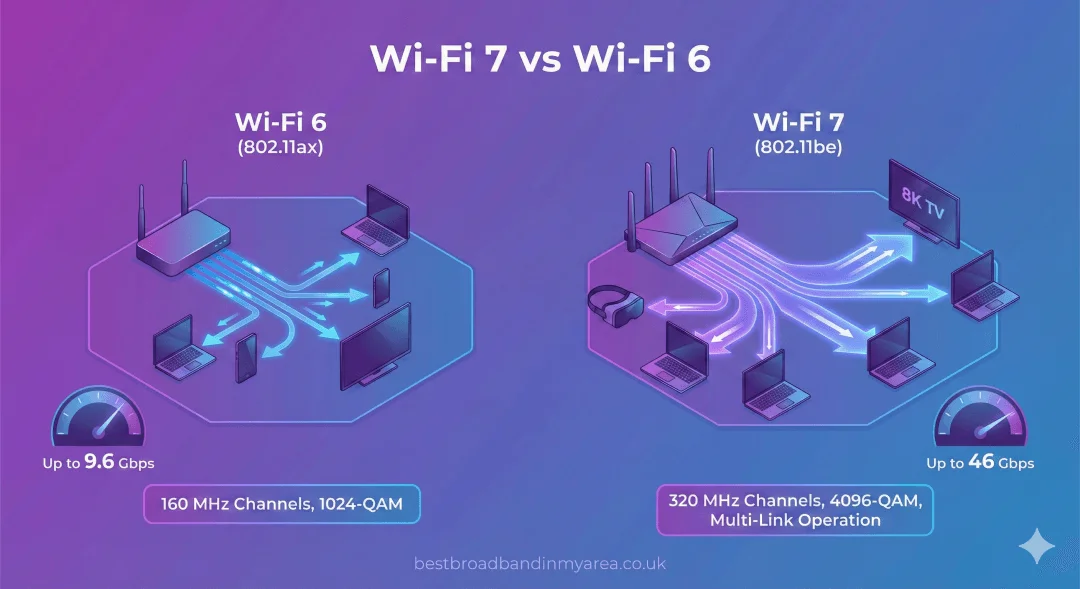
Understanding Wi-Fi 6 (802.11ax)
Launched in 2019, Wi-Fi 6 brought a focus on network efficiency, particularly in environments with many connected devices. It introduced technologies like Orthogonal Frequency-Division Multiple Access (OFDMA) and Multi-User, Multiple-Input, Multiple-Output (MU-MIMO) to allow multiple devices to communicate simultaneously without slowing down the network. Wi-Fi 6 supports theoretical maximum speeds of up to 9.6 Gbps.
The Major Leap Forward: Key Features of Wi-Fi 7 (802.11be)
Wi-Fi 7 is not just an incremental update; it’s a revolutionary upgrade built for the future of connectivity. Here’s how it surpasses Wi-Fi 6:
- Extreme Speed: Wi-Fi 7 boasts a theoretical maximum speed of up to 46 Gbps, which is more than four times faster than Wi-Fi 6. This speed increase is crucial for demanding applications like 4K/8K video streaming, augmented and virtual reality, and cloud gaming.
- Wider Channels: Wi-Fi 7 doubles the channel width of Wi-Fi 6 from 160 MHz to 320 MHz, available in the 6 GHz band. Think of it as widening a two-lane road to a four-lane motorway, allowing significantly more data to be transmitted at once, which reduces congestion and increases throughput.
- Multi-Link Operation (MLO): This is one of Wi-Fi 7’s most innovative features. While Wi-Fi 6E introduced the 6 GHz band, devices could only connect to one band at a time (2.4, 5, or 6 GHz). MLO allows a device to connect and transmit data over multiple bands simultaneously. This improves speed, reduces latency, and provides a more reliable connection by allowing the device to seamlessly switch between bands to avoid interference.
- Higher Data Density (4K QAM): Wi-Fi 7 improves data transmission by using 4096-QAM (Quadrature Amplitude Modulation), an upgrade from Wi-Fi 6’s 1024-QAM. This allows each signal to carry more data, resulting in a 20% increase in peak data rates and a more efficient use of the wireless spectrum.
Comparison Table: Wi-Fi 6 vs Wi-Fi 7
| Feature | Wi-Fi 6 (802.11ax) | Wi-Fi 7 (802.11be) |
|---|---|---|
| Max Theoretical Speed | 9.6 Gbps | 46 Gbps |
| Channel Width | 160 MHz | 320 MHz |
| Modulation | 1024-QAM | 4096-QAM |
| Key Features | OFDMA, MU-MIMO | Multi-Link Operation (MLO) |
| Primary Focus | Network efficiency | Extreme speed & low latency |
WiFi 7 vs WiFi 6: Is it Worth It?
You've probably seen WiFi 7 around more and more but is it worth the upgrade from WiFi 6 or 6E? Here's a video describing the real differences so you can decide.

What Does This Mean for You?
For the average household, Wi-Fi 7 offers a significant improvement in performance, especially in busy homes with numerous connected devices. The technology is designed to handle simultaneous high-bandwidth activities such as a family streaming movies in 4K, a teenager gaming online with low latency, and a remote worker on a video call – all without a drop in performance.
While Wi-Fi 6 is a solid choice for most people today, if you are looking to future-proof your home network, support the latest multi-gigabit broadband packages, and ensure a smooth experience for the next generation of smart home devices, Wi-Fi 7 is the clear choice.
Which UK ISPs provide Wi-Fi 7 routers?
Several UK internet service providers are now offering Wi-Fi 7 compatible routers, primarily with their top-tier fibre packages.
- EE: Provides the Smart Hub Pro with Wi-Fi 7 technology for its full fibre plans.
- Sky: Has launched the new Gigafast+ Hub, which uses Wi-Fi 7, with its 5 Gbps full-fibre package.
- Vodafone: Offers the Ultra Hub 7, a Wi-Fi 7 router, with its Pro 3 Broadband package.
- Lightspeed: Was an early adopter, offering a full range of eero Wi-Fi 7 routers with all its broadband packages.
- Connect Fibre & YouFibre: Also offer Wi-Fi 7 routers as standard with their fastest plans.
As the technology becomes more widespread, expect other major providers like BT and Virgin Media to follow suit.
Related Articles

UK Towns Hit Hardest by Evening Broadband Congestion Exposed
New independent speed test data exposes the UK towns worst affected by evening broadband congestion. Learn how the 9pm copper crash hits your speeds.

Zen Broadband Review
Zen Broadband Review – Are they any good? When it comes to choosing a new broadband provider in the UK, the sheer number of options can be overwhelming. But if you’re looking for an alternative to the big names like BT, Virgin Media, and Sky, you’ve probably come across Zen. This in-depth Zen broadband review […]
Need More Info?
- Wi-Fi Alliance – For official information on Wi-Fi standards, you can visit the Wi-Fi Alliance website at: https://www.wi-fi.org/
- CNET – The article covers the era of Wi-Fi 7, its benefits, and certification: https://www.cnet.com/home/internet/what-is-wifi-7/
- Qualcomm is a leading manufacturer of Wi-Fi chips. This page offers a professional look at the technology, including concepts like Multi-Link Operation (MLO) from an industry perspective: https://www.qualcomm.com/products/technology/wi-fi/wi-fi-7
Wi-Fi 7 Frequently Asked Questions
Is Wi-Fi 7 backwards compatible?
Yes, Wi-Fi 7 routers are designed to be fully backwards compatible with all previous Wi-Fi standards, including Wi-Fi 6, 5, 4, etc.
Do I need a new router and new devices for Wi-Fi 7?
To get the full benefits of Wi-Fi 7, you need a Wi-Fi 7 compatible router and devices that support the standard. Your existing devices will still connect, but at their older standard's speed.
Is Wi-Fi 7 available yet?
Yes, Wi-Fi 7 is available. The Wi-Fi Alliance, which certifies Wi-Fi products, launched its certification programme in early 2024. Many companies are already releasing routers and devices that support the new standard.
Is Wi-Fi 7 available in the UK?
Yes, Wi-Fi 7 is available in the UK. Broadband providers like Vodafone and EE offer Wi-Fi 7 routers with their premium plans. You can also purchase Wi-Fi 7 routers and components from retailers.
Will Wi-Fi 7 be worth it?
Wi-Fi 7 provides significant improvements over previous generations, with theoretical speeds up to 46 Gbps. It's especially beneficial for applications that demand high speed and low latency, such as 8K video streaming, cloud gaming, and AR/VR. If your current Wi-Fi setup meets your needs, you may not need to upgrade yet, but Wi-Fi 7 is a solid option for future-proofing your home network.
Does Wi-Fi 7 penetrate walls better?
No, Wi-Fi 7 doesn't improve wall penetration. It operates on the same frequency bands as older standards (2.4 GHz, 5 GHz, and 6 GHz). While the 2.4 GHz band is better at penetrating physical barriers, the higher frequencies like 5 GHz and 6 GHz offer faster speeds but are more easily blocked by walls and floors. For better coverage in a multi-story or large home, it is still recommended to use multiple access points.
What devices will use Wi-Fi 7?
A growing number of devices, including smartphones, laptops, and gaming consoles, are being released with Wi-Fi 7 support. Examples include the iPhone 16 series, Google Pixel 9 series, Samsung Galaxy S25 series, and gaming consoles like the PlayStation 5 Pro and Xbox Series X.
Can older devices use Wi-Fi 7?
Yes. Wi-Fi 7 is backward compatible, which means older devices that use Wi-Fi 6E, Wi-Fi 6, or even Wi-Fi 5 will still be able to connect to a Wi-Fi 7 router. However, they will not be able to take advantage of Wi-Fi 7’s enhanced features and speeds.
Do you need Windows 11 for Wi-Fi 7?
Yes, you need Windows 11 to fully utilise Wi-Fi 7's features. Intel's Wi-Fi 7 products, for example, have limited functionality on Windows 10, and Wi-Fi 7 features are available starting with Windows 11 24H2.
Can an iPhone connect to Wi-Fi 7?
Yes, the iPhone 16 models and newer support Wi-Fi 7.
Do I need Wi-Fi 7 in my house?
Whether you need Wi-Fi 7 depends on your usage. If you are experiencing slow speeds, network congestion, or plan on using high-bandwidth applications like 8K streaming or VR, then a Wi-Fi 7 router could be a worthwhile investment. It offers future-proof technology and improved performance in high-density environments.