
Broadband Price Increases 2026
Broadband Price Increases 2026 – Predicted Hikes, Dates & How to Escape Them
April 2026 is set to bring another wave of significant broadband price increases, with predictions estimating mid-contract hikes of between 7% and 9% for millions of UK customers. If you are with a major provider like BT, EE, Plusnet, TalkTalk, or Vodafone, your monthly bill will almost certainly rise on or around April 1st, 2026.
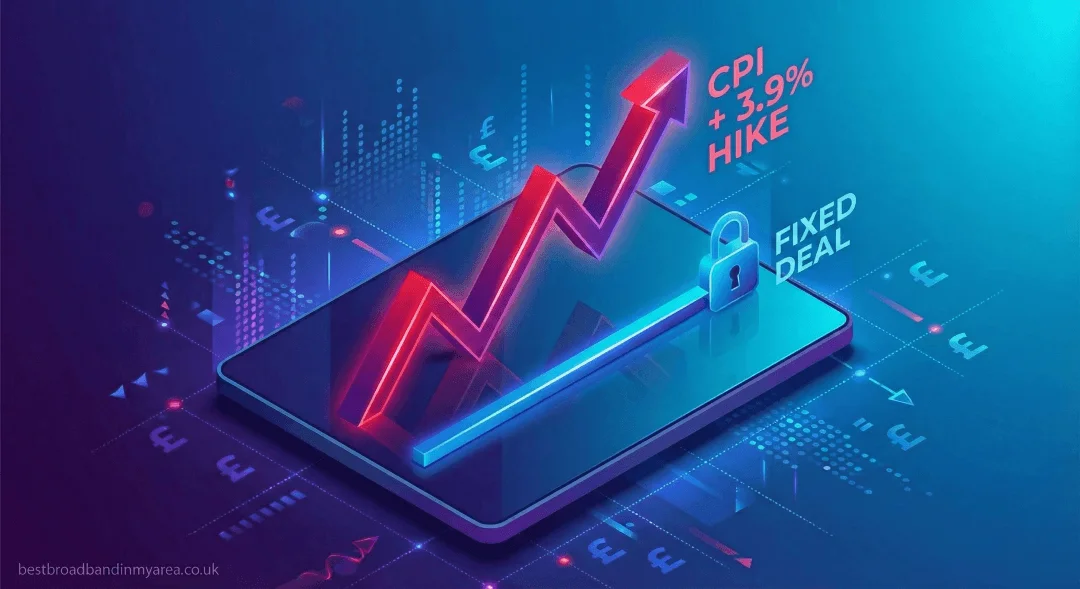
This increase is calculated based on the Consumer Price Index (CPI) or Retail Price Index (RPI) figure published in January/February 2026, plus an arbitrary surcharge of typically 3.9%. Unless you are out of contract or with a fixed-price alternative network (Alt-Net), you likely cannot leave penalty-free.
At a Glance: What You Need to Know
- Prices will officially rise on or around April 1st, 2026.
- Expect bills to increase by CPI + 3.9% (approx. 7-9% total).
- Most customers on BT, EE, Plusnet, Vodafone, TalkTalk, and Virgin Media O2.
- Sky and NOW Broadband generally allow you to leave penalty-free if they hike prices, though they don’t use the fixed CPI formula.
- You can switch to an “Alt-Net” provider that promises fixed prices, or haggle for a better deal if you are out of contract.
Why Are Broadband Prices Going Up in 2026?
It feels like we just finished paying for the last round of hikes, and yet here we are again. The reason your bill is skyrocketing isn’t necessarily because your internet got faster or the service improved. It’s built into the fine print of the contract you signed.
Most major UK Internet Service Providers (ISPs) include a clause in their terms and conditions that allows them to adjust prices annually in line with inflation. They use two main metrics: CPI (Consumer Price Index), which tracks the rate at which the prices of goods and services rise, and RPI (Retail Price Index), an older measure of inflation that is typically higher than CPI.
The problem isn’t just inflation. It’s the “plus” part. Providers like BT and Vodafone take the inflation figure, let’s hypothetically say it sits at 4% in January 2026 – and add their own 3.9% surcharge on top. That means you get hit with a 7.9% increase.
They argue this covers rising wholesale costs and network investments, such as the UK Copper Switch Off. Consumer groups, however, argue it’s an unfair tax on loyalty that generates massive profit margins.
Predicted Price Rises by Provider for 2026
Not every provider plays by the same rules. Some are notably more aggressive than others. Below is a breakdown of how the biggest names in the industry are expected to handle the April 2026 shift.
| Provider | Formula Used | Predicted Hike (Est.) | Can You Exit? |
|---|---|---|---|
| BT Broadband | CPI + 3.9% | ~7.9% | No (Contract Locked) |
| EE | CPI + 3.9% | ~7.9% | No (Contract Locked) |
| Plusnet | CPI + 3.9% | ~7.9% | No (Contract Locked) |
| Vodafone | CPI + 3.9% | ~7.9% | No (Contract Locked) |
| TalkTalk | CPI + 3.7% | ~7.7% | No (Contract Locked) |
| Virgin Media O2 | RPI + 3.9% (Typical) | ~8-9% | Sometimes (Check Contract) |
| Sky Broadband | Discretionary | ~5-7% | Yes (Usually) |
| NOW Broadband | Discretionary | ~5-7% | Yes (Usually) |
The ‘CPI + 3.9%’ Club
These providers are contractually locked into increasing your bill based on the December 2025 CPI figure (published in January 2026) plus 3.9%. This includes BT, EE, and Vodafone. It also includes Plusnet; you can read our full Plusnet Broadband Review to see if their customer service justifies the extra cost during these hikes.
The ‘Right to Exit’ Group
Sky Broadband and NOW Broadband operate differently. They do not typically write a fixed percentage rise into their contracts. Instead, they announce a price rise (often lower than the others) closer to the date. Crucially, if Sky raises your price mid-contract, they usually allow you to leave penalty-free within 30 days of notification. This makes them a safer bet for those worried about getting trapped.
Related Articles

Plusnet Broadband Review and Deals
Plusnet Broadband Review: Is Plusnet broadband any good? Searching for the ideal broadband provider in the UK can feel a little overwhelming. With so many options available, a thorough Plusnet broadband review is essential to help you decide if this popular Internet Service Provider is the right choice for you. Plusnet, a subsidiary of the […]
Full Fibre UK AltNets – Compare Faster Cheaper Broadband Deals
Why Smaller Full Fibre UK Altnets May be Your Best Deal The UK internet market is changing fast. You don’t have to stick with BT, Sky, or Virgin Media. A new group of companies called AltNets (Alternative Networks) are installing brand-new, cutting-edge fibre cables right into homes, offering you faster, more reliable internet for less […]
Broadband Price Increase 2026 – The Math Behind the Madness
Let’s look at the hard numbers. Percentages can feel abstract until you see what they do to your bank account over 12 months.
Scenario:
You are currently paying £35.00 per month for a Fibre 2 package.
The Prediction:
- Hypothetical CPI (Jan 2026): 4.0%
- Provider Surcharge: 3.9%
- Total Increase: 7.9%
The Calculation:
£35.00 x 7.9% = £2.77 increase per month.
The Result:
Your new bill is £37.77. Over the remaining 12 months of a contract, you are paying an extra £33.24. That might not sound like a life-changing amount, but when you stack it with mobile phone contract hikes, streaming service increases, and energy costs, it bleeds your disposable income dry.
How to Escape the April 2026 Price Hike
You are not powerless. While the contracts are watertight, there are strategies you can deploy to mitigate or entirely avoid these costs.
1. Check Your Contract Status Immediately
This is step one. Log into your ISP’s portal or check your email archives. If your minimum term has ended (usually 18 or 24 months), you are technically a “free agent.” You can switch tomorrow without paying a penny in exit fees. If you are out of contract, do not stay. The out-of-contract prices are often nearly double the introductory rates. Switching is the single most effective way to lower your monthly outgoings.
2. The ‘Mid-Contract’ Loophole
If you are still in contract, leaving is harder. If you try to cancel, you will be hit with an Early Termination Charge (ETC). However, there is a specific exception. If your provider raises the price higher than what was agreed in your terms and conditions, you can leave for free.
This is why Sky customers often get a “Get Out of Jail Free” card. Since Sky doesn’t bake the “CPI + 3.9%” formula into the contract as strictly as BT, their price rises can trigger a 30-day window where you can cancel without penalty. Watch your email inbox in February 2026 like a hawk.
3. Haggle Like Your Wallet Depends on It
If you are out of contract but like your current service, you don’t actually have to leave. You just have to threaten to. ISPs rely on inertia. Call the “Retentions” department and use a script. Tell them you’ve found a cheaper deal with a competitor and you are leaving unless they match it and freeze the April hike. They will almost always offer a discount.
4. Switch to an Alt-Net (The Price Freeze Heroes)
This is the smartest long-term play. The UK market is currently flooded with “Alt-Nets” (Alternative Networks). These are smaller, independent providers building their own full-fibre infrastructure, separate from the Openreach network used by BT and Sky.
Companies like Community Fibre, Hyperoptic, Gigaclear, and YouFibre are desperate for market share. To get it, they often promise no mid-contract price rises. If you lock in a deal for £25/month for 24 months with an Alt-Net, you pay £25/month for 24 months. No April surprises. For a deeper dive into these providers, check our guide on Full Fibre UK Altnets.
Social Tariffs
If you are on benefits, specifically Universal Credit, Pension Credit, or Employment and Support Allowance, you are likely eligible for a Social Tariff. These are special, low-cost broadband packages mandated by the government. They are typically cheap (£12-£20/month), offer decent speeds, and crucially, most are exempt from price hikes. Major providers offer them, but they don’t advertise them loudly.
Is 5G Broadband a Viable Escape Route?
If your fixed-line broadband is becoming too expensive and you don’t have access to a cheap Alt-Net, 5G home broadband is a legitimate contender. Providers like Three and EE offer 5G hubs that you simply plug into the wall. No engineer visits, no line rental.
The pros are clear: it’s often cheaper and contracts can be as short as one month. However, it is signal dependent. Before you jump ship, read our analysis on 5G: A Game Changer for Broadband? to understand the technical limitations regarding latency and stability.
Understanding the ‘Glossary of Grief’
To navigate the 2026 hikes, you need to speak the language. ISPs love using acronyms to confuse you.
- CPI (Consumer Price Index): The main inflation figure.
- Wholesale Costs: What your ISP pays Openreach to use the cables.
- Equivalency: The rule that says switching should be easy. This has been improved massively by One Touch Switch regulations.
- Minimum Term: The “handcuff” period of your contract.
The April 2026 price hikes are a frustrating reality of the broadband market, but you don’t have to simply accept them. The gap between loyalty prices and new customer deals is wide. If you are out of contract, you are effectively donating money to your provider’s shareholders.
Check your dates. Check your status. If you are free to move, look at the smaller, faster, cheaper providers in your area. Compare Broadband Deals now and lock in a price that won’t give you a nasty surprise when April rolls around.
Frequently Asked Questions (Broadband Price Hikes)
If I have a bundle with TV and Mobile, does the price rise apply to the whole bill?
This is a common "gotcha" that catches thousands of customers out. Generally, yes, the percentage increase is applied to the total monthly cost of your package, not just the broadband element. If you are with Virgin Media or Sky and you bundle premium TV channels (like Sky Sports or Cinema) and a SIM card, a 7-9% rise on a £100 bill is significantly more painful than on a £30 broadband-only bill. However, there is a nuance: some "Volt" or combined packages split the bill between two providers (e.g., Virgin Media for broadband, O2 for mobile). In these cases, you might see two separate price rises applied at different times or rates.
What is the difference between a 'Contractual' rise and an 'Ad-hoc' rise?
This distinction is the key to escaping your contract. A Contractual Rise (used by BT, EE, Plusnet, Vodafone) is written into the T&Cs you signed. You agreed to it on day one, so you have no legal right to leave penalty-free when it happens. An Ad-hoc Rise (often used by Sky and occasionally Virgin Media) is a decision the provider makes on the fly to increase prices.
Because you didn't explicitly agree to this specific future rise when you signed up, Ofcom rules state they must give you 30 days to leave without penalty. Always check the letter they send you: if it says "Right to Cancel," it is an ad-hoc rise.
My discount is ending in April. Is that the same as a price hike?
No, and it is vital you know the difference. If you signed up for an 18-month deal at £25/month which reverts to £45/month at the end of the term, that £20 jump is not an inflation price hike; it is your "introductory offer" expiring. The inflation hike (CPI + 3.9%) is then usually applied to that new, higher price. If your contract is ending, you are being hit with a "double whammy." The good news? If your discount is ending, you are likely out of contract, meaning you can switch immediately to a new provider without paying a penny in exit fees.
Can I use the 'Material Detriment' clause to cancel?
The "Material Detriment" clause is a piece of Ofcom regulation that allows you to exit a contract if a provider makes changes that significantly harm you.
While price rises should count, big ISPs have circumvented this by writing the exact inflation formula into the contract.
Since they told you it would happen, they argue it isn't a "surprise" detriment. However, you can use this clause if the price rise is significantly higher than the formula, or if the provider changes other core terms like reducing your upload speeds or removing a bundled service at the same time as the price hike.
How exactly is the Early Termination Charge (ETC) calculated?
Don't assume the exit fee is just "monthly cost x months left." It is often slightly cheaper, but still expensive. Providers usually calculate the fee based on the remaining monthly payments, but they then deduct VAT (20%) and the costs they save by not supplying you with service (like wholesale line rental). For example, if you pay £30/month and have 6 months left, the fee might be closer to £140 rather than £180. You can usually find an "Early Termination Charge" calculator on your provider's help pages, or ask their live chat for an exact "settlement figure" before you make a decision.
Why hasn't Ofcom banned these 'Inflation + 3.9%' hikes yet?
They are trying to. Ofcom proposed a ban on inflation-linked price rises in late 2023, arguing that customers cannot predict the future economy and therefore cannot sign a contract with "informed consent." They want to force providers to state price rises in "pounds and pence" (e.g., "Your bill will rise by £1.50 in April"). However, regulatory wheels turn slowly.
While the consultation has finished, the implementation period means that for April 2026, many existing contracts will likely still operate under the old, confusing percentage rules. We expect the "pounds and pence" rule to fully take over for contracts signed after mid-2026.
Do 'Fixed Price' promises from Alt-Nets last forever?
Marketing can be slippery. When an Alt-Net like Community Fibre or Hyperoptic offers a "Fixed Price," it almost always means "Fixed for the minimum term" (e.g., 24 months). Once that term ends, the price can, and usually does, jump significantly to their "standard" rate.
The benefit is that you are shielded from the April inflation spike during your contract, but you must be disciplined enough to switch again the moment that fixed term expires.
Does the price hike affect my 'Boost' or 'Add-on' services?
This varies by provider. For some, the CPI + 3.9% is applied to the base broadband price, but "add-ons" like Call Plans, Whole Home Wi-Fi guarantees, or Static IPs are frozen. For others (like EE), the percentage increase applies to the entire allowable monthly recurring charge. Check your bill breakdown. If you are paying £5/month for a Wi-Fi booster you don't use, cancelling that add-on (which is often allowed mid-contract) could offset the price rise of your main broadband connection.
I am switching to avoid the hike. Will I pay a setup fee with the new provider?
Possibly. While switching saves money in the long run, many providers charge a nominal "activation fee" or "delivery fee" for the new router, typically between £0 and £30. However, during the competitive "price hike season" (February to April), many ISPs waive these fees to poach angry customers from rivals.
Our broadband comparison tool shows you which Internet Service Providers offer free setup.