
UK Copper Switch-off – What You Need to Know
The UK Copper Switch-Off 2026
Will Your Broadband and Landline Stop Working?
Yes, your traditional landline’s disappearing. If you currently plug your home telephone directly into the rectangle wall socket, your service is going to stop working before 2027. The UK Copper Switch-Off isn’t a suggestion. It’s a mandatory infrastructure migration managed by Openreach that affects every household and business relying on the old Public Switched Telephone Network (PSTN).
You’ve got to move to a digital alternative, such as Digital Voice or mobile-based solutions, to keep making calls. This shift also means your broadband needs to change from standard ADSL or FTTC to SoGEA or Full Fibre. If you don’t act, you’re risking total disconnection.
Key Takeaways on the UK Copper Switch-Off
- The PSTN network shuts down completely in January 2027, but “Stop Sell” notices are already active in 80% of UK exchanges.
- Your phone must plug into your broadband router, not the wall socket.
- Most users will need to switch to Single Order Generic Ethernet Access (SoGEA) or Full Fibre (FTTP).
- Old copper lines worked during power cuts. Digital lines don’t. You need a battery backup unit if you rely on telecare alarms.
- Switching voluntarily now usually secures cheaper rates than rolling over legacy copper contracts.

Why Is the UK Copper Switch-Off Happening?
The current telephone network’s ancient. Some of the copper cables running under British streets were laid in the 19th century. They’re fragile, expensive to maintain, and incapable of handling the data speeds modern life demands. Openreach’s bleeding money trying to patch up this decaying grid.
The goal’s modernisation. Voice calls don’t need a dedicated physical wire anymore. They’re data. By moving voice traffic to the internet (VoIP), Openreach can retire the copper network. This frees up engineering resources to focus on the full rollout of gigabit-capable fibre.
It’s efficient. But for the consumer, it’s a headache. You’ve got to change how you connect. You might need a new router. You definitely need to check if your alarm system works.
The Problem with “If it ain’t broke, don’t fix it”
You might think your current line works fine. It doesn’t matter. The exchange equipment that powers that line is being turned off. It’s like analogue TV. When the signal stopped, your old TV set became a paperweight unless you bought a digibox. The UK Copper Switch-Off is the exact same process, just for your phone and internet.
Ofcom supports this because the old network’s failing. Fault rates on copper lines are significantly higher than on fibre. We’re paying for a service that degrades every time it rains.
Related Articles
VodafoneThree Sign CityFibre Deal to Expand UK 5G and Fibre
VodafoneThree has signed a major VodafoneThree CityFibre full fibre agreement to power its growing 5G mobile network and home internet services. The newly merged company will use CityFibre as a preferred supplier to connect its mobile masts and expand residential internet connections.

Amazon Satellite Broadband 2026 UK Launch, Speeds and Prices
Amazon satellite broadband completely alters how rural homes connect to the internet. The new low Earth orbit constellation delivers gigabit speeds to properties entirely ignored by traditional providers. We are looking at a system designed to undercut existing competitors directly.
The “Stop Sell” Phase: You Might Already Be Affected
You don’t have to wait until 2027 to feel the impact. Openreach operates a “Stop Sell” policy. Once 75% of premises in a specific exchange area can access ultrafast Full Fibre, that exchange stops selling copper products.
If you live in a “Stop Sell” area, you can’t:
- Renew an existing copper contract.
- Switch to a new provider using copper.
- Upgrade your speed while keeping a copper landline.
You’re forced to upgrade. This catches people out. You call your ISP to negotiate a better deal, and they tell you that you can’t have your old package anymore. You’ve got to take the digital version.
What is SoGEA?
You’ll hear this acronym a lot. SoGEA stands for Single Order Generic Ethernet Access. It’s the bridge technology for people who can’t get Full Fibre yet.
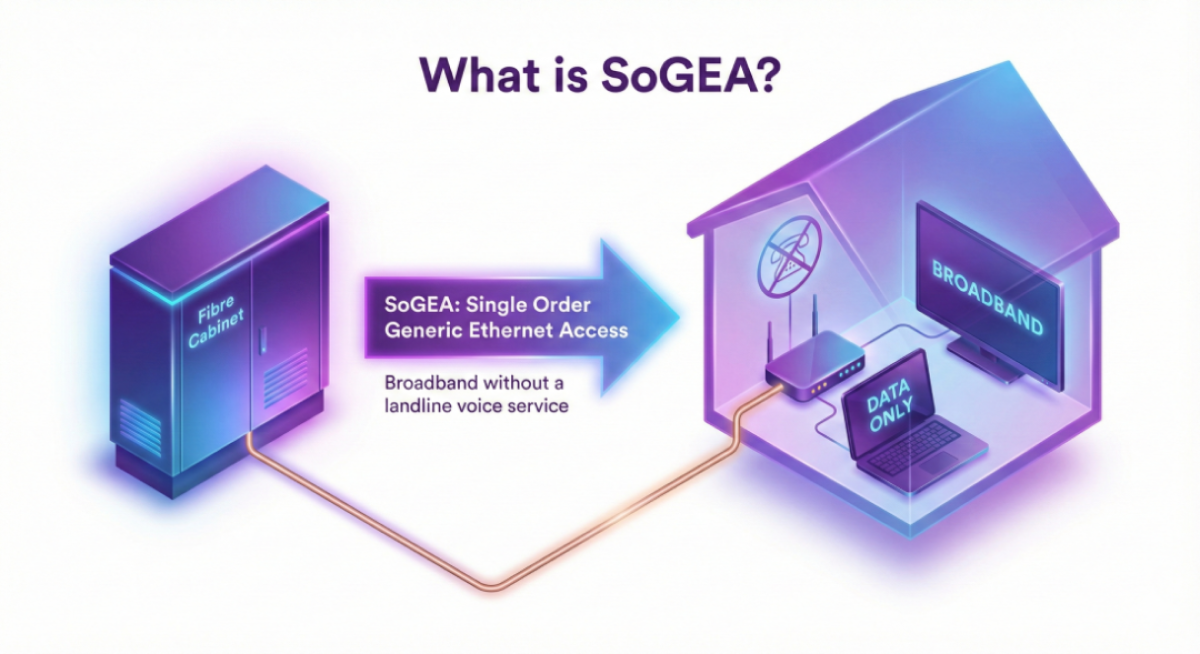
Previously, you paid for a phone line (WLR) and then paid for broadband on top of it. SoGEA strips out the voice component. You buy the data pipe. That’s it. If you want a phone number, it’s added as a digital app or service on top of that data pipe. It’s cheaper for ISPs to manage, and it eliminates the dreaded “line rental” distinct from your broadband cost.
Digital Voice and Your ISP
Every provider handles the UK Copper Switch-Off differently. They use different names for the same technology. It’s confusing. Here’s a breakdown of what the major players are doing.
| Provider | Service Name | Key Requirement |
|---|---|---|
| BT | Digital Voice | Must use Smart Hub 2. Phones plug into the router. |
| Virgin Media | Switchover (Fibre Phone) | Phone plugs into the Virgin Hub. |
| Sky | Internet Calls | Router handles voice data. Digital by default on new deals. |
| TalkTalk | Digital Voice | Uses the Amazon eero router with a digital adapter. |
BT Digital Voice
BT is the most aggressive with its “Digital Voice” campaign. They ship you a new Smart Hub 2. You can’t plug your old phone into the wall. You must plug it into the back of the hub, or use their new wireless handsets. BT’s faced backlash because this breaks third-party extensions. If you’ve got phone sockets in your bedroom or kitchen, they’ll stop working. You need Digital Voice adapters to bridge the gap.
Virgin Media O2
Virgin Media operates its own cable network, but they’re also ditching old phone sockets. They call it “Switchover.” They’re moving customers to fibre phone lines. You plug the phone into the Virgin Hub. It’s the same principle as the Openreach switch-off but on a private network.
Sky and TalkTalk
Sky and TalkTalk use the Openreach network. They’re rolling out “Internet Calls.” They’re less pushy than BT but are bound by the same “Stop Sell” rules. If you sign a new contract with Sky today, you’re likely getting a digital line by default.
The Telecare and Alarm Crisis
This is the most dangerous part of the switch. Old copper phone lines carried a low-voltage charge. If the power went out in your house, your corded phone still worked. You could call 999.
Digital Voice requires mains power. If you have a power cut, your phone won’t work.
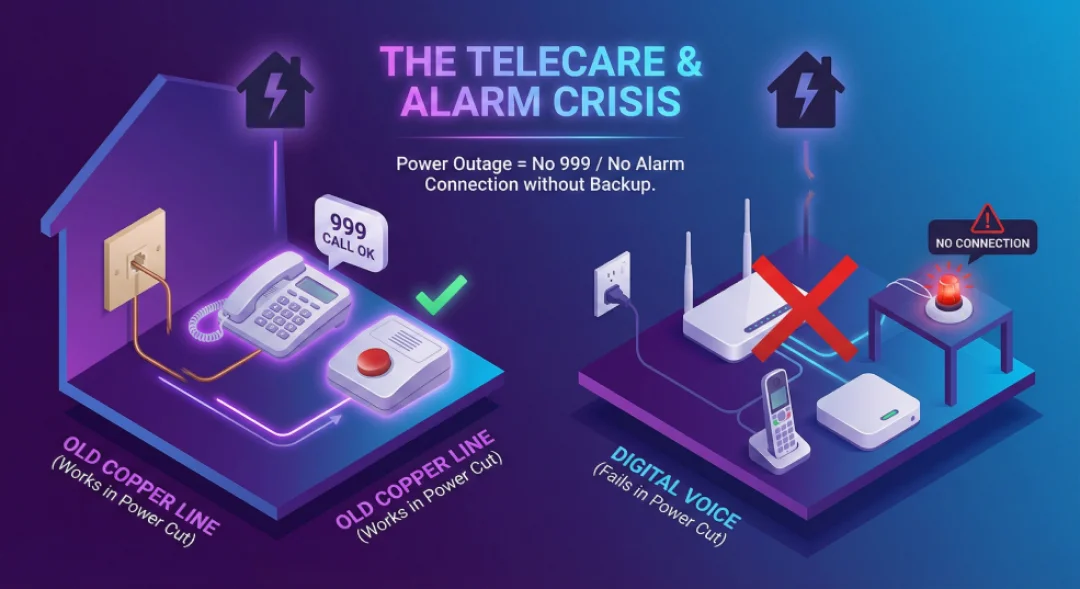
This is a threat to the 1.7 million people in the UK who use personal telecare alarms (red button lanyards). These devices often dial out via the phone line. When that line goes digital, older alarms might fail to connect or fail completely during a blackout.
Your Responsibilities vs. ISP Responsibilities
ISPs are legally required to identify vulnerable customers. If you’re flagged as vulnerable, they must provide a battery backup unit (BBU) that keeps the router alive for at least one hour during a power cut.
Don’t assume they know you’re vulnerable. You’ve got to tell them. If you use a third-party alarm monitoring service (like Age UK), you must contact them to ask if your device is “digital ready.” Don’t wait until the engineer arrives to check this.
The Technical Difference between Full Fibre vs. SoGEA
The UK Copper Switch-Off pushes you toward two main products. Understanding the difference prevents you from being upsold something you don’t need.
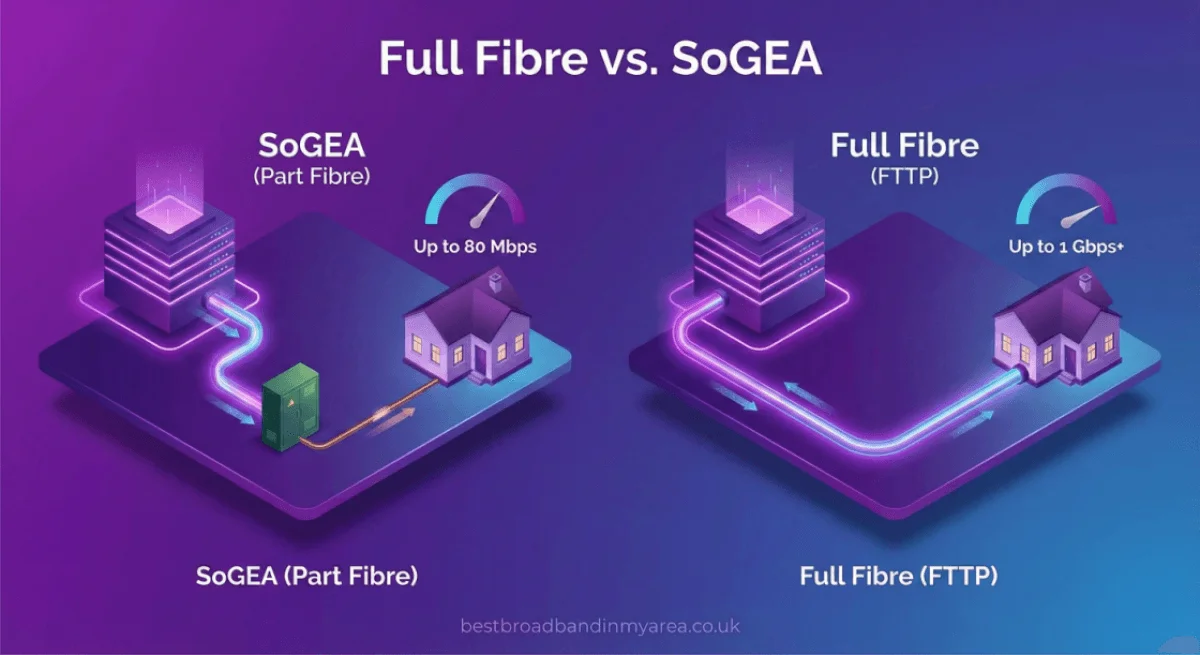
1. SoGEA (Part Fibre)
This uses the existing green cabinet on your street. A fibre cable goes to the cabinet, but a copper wire still runs from the cabinet to your house. It’s “fake fibre.” You get speeds up to 80Mbps. It’s reliable enough for streaming but suffers from distance attenuation. The further you are from the cabinet, the slower it gets.
2. FTTP (Full Fibre)
This is the gold standard. A glass cable runs all the way into your home. No copper. It supports speeds up to 1.6Gbps (or higher with providers like Community Fibre). It’s immune to interference. It doesn’t slow down when your neighbours go online.
If you can get FTTP, take it. The price difference between SoGEA and FTTP is narrowing. Sometimes, Full Fibre’s cheaper because ISPs are desperate to move people off the copper maintenance books.
Enter your postcode into our broadband coverage checker to see if your postcode’s ready for the jump to gigabit full fibre speeds.
How to Switch Without Losing Your Number
A major fear’s losing the home phone number you’ve had for thirty years. Number porting’s possible, but it’s fragile.
If you switch providers during the UK Copper Switch-Off, the porting process is usually handled by the gaining provider. You’ve got to indicate clearly that you want to keep your number.
Warning: If you cancel your old contract before the new one’s active, you’ll lose the number immediately. It goes back into the recycling pot. Never cancel manually. Let the new ISP do the “Gaining Provider Led” switch.
There’s a hiccup. If you move from a copper line to a purely mobile broadband solution (like a 5G Hub from Three), you can’t port a landline number to it directly. You’d need a VoIP host. This is complex for average users. Sticking with fixed-line broadband’s safer for number retention.
For more on switching logistics, read our guide on One Touch Broadband Switching.
Why You Should Switch Now
Don’t wait for the forced migration letter. When an ISP’s forced to move you, they hold all the cards. They’ll move you to their default digital tariff. This is rarely the cheapest option.
By proactively searching for a new deal now, you enter the market as a “new customer.” New customers get acquisition discounts. Existing customers get loyalty penalties.
Use the anxiety of the switch-off to your advantage. Go to a comparison site. Look for SoGEA or FTTP deals. You’ll likely find you can double your speed and halve your bill, all while ticking the box for the inevitable digital upgrade.
Frequently Asked Questions regarding the UK Copper Switch-Off
1. Will the UK Copper Switch-Off happen in my area soon?
It’s likely already impacting your options. While the final disconnection of the PSTN network is set for January 2027, the “Stop Sell” phase is rolling out exchange by exchange right now. Once 75% of your area has access to Full Fibre, Openreach triggers a “Stop Sell” notice.
This means if you try to switch providers or renew your contract today, you won’t be offered a traditional copper line. You’ll be forced onto a digital alternative immediately. You can check the specific status of your local exchange using the Openreach Fibre postcode checker.
2. Do I have to pay for an engineer visit?
It depends on what you’re switching to. If you’re moving to SoGEA (which uses your existing copper street wires), the switch is usually remote and happens at the exchange level,no engineer needed. However, if you’re upgrading to Full Fibre (FTTP), an engineer must physically run a new glass cable from the street to your property and drill a hole to install an Optical Network Terminal (ONT) on your wall. Most ISPs, including Sky and BT, currently waive this installation fee to encourage people to upgrade voluntarily.
3. Will my panic alarm work with Digital Voice?
This is a critical safety issue. Many older telecare devices rely on analogue tones that get scrambled over VoIP digital lines. Even if they do connect, they will fail instantly during a power cut because your router will lose power.
You must contact your alarm provider (e.g., Age UK, Secom) before you switch. They may need to send you a new “digital ready” unit that contains a roaming mobile SIM card, ensuring it works independently of your broadband connection and mains power.
4. Can I keep my old landline phone handset?
Yes, in most cases, you don’t need to bin your existing phones. However, the days of plugging them into the wall sockets in the hallway or bedroom are over. You’ll need to plug the main base station directly into the phone port on the back of your new broadband router. If you have additional corded phones in other rooms, they will stop working.
To fix this, you can buy simple “Digital Voice Adapters” from your ISP, or upgrade to a DECT cordless phone system where the satellite handsets connect wirelessly to the main base station.
5. Does Digital Voice cost more?
Technically, the “line rental” component is vanishing. You’re now paying purely for a data connection (broadband). In the short term, digital packages are often cheaper or price-matched to legacy deals because ISPs want to migrate you quickly. However, be aware that while the connection is cheaper to maintain, call plans are still chargeable.
If you want “Anytime Calls” or international minutes, these are added as “bolt-ons” to your broadband subscription, just like before.
6. What happens if the internet goes down?
Unlike the old copper network, which carried its own low-voltage power, Digital Voice is 100% reliant on your internet connection. If your broadband cuts out, your phone line cuts out. You cannot make calls, including to 999. We strongly recommend keeping a charged mobile phone nearby for emergencies.
If you live in an area with poor mobile signal, ask your provider about “Hybrid” broadband solutions (like BT Hybrid Connect), which automatically switch your router to a 4G/5G mobile signal if the fixed line fails.
7. Is the sound quality better?
Yes, significantly. Digital calls use “HD Voice” technology (often using the G.722 codec), which captures a wider range of audio frequencies than the muffled analogue PSTN network. Background hiss and crackle are virtually eliminated. However, this clarity depends on your broadband bandwidth. If someone is downloading a massive file on a very slow connection (under 10Mbps), you might experience “jitter” or robotic-sounding voice, though this is rare on modern fibre connections.
8. What if I don’t have (or want) broadband?
This is a common worry for older residents. If you currently only have a landline and don’t use the internet, you won’t be forced to pay for a high-speed Netflix-ready package. ISPs are creating specific “Voice Only” digital plans.
They will install a router that is locked down to only handle voice traffic (limiting speeds to around 0.5Mbps). You’ll still have a box in your house, but you won’t be paying for expensive fibre broadband you don’t use.
9. Can I opt out of the switch?
No, this is a nationwide infrastructure retirement, not a marketing campaign. The hardware at the telephone exchanges is being physically switched off and removed.
While providers initially paused forced migrations for vulnerable customers (aged 70+ or with medical needs) following a government intervention in late 2023, the rollout has restarted with stricter safety checks. You cannot insist on keeping a copper analogue line indefinitely.
10. Will I lose my phone number?
You shouldn’t, but you have to be careful. Under the new “One Touch Switch” regulations, your number should port automatically if you let the new provider handle the process. Crucially, do not cancel your current contract yourself.
If you call your old provider to cancel before the new line is active, your number is “ceased” and returned to the number pool, often making it irretrievable. Always follow the “Gaining Provider Led” process to keep your digits safe.
11. What about my fax machine?
Fax machines are the biggest casualty of this switch. They rely on analogue audio signals that often fail when compressed into digital data packets (causing transmission errors).
While you can try adjusting the baud rate on your machine, it’s unreliable. The industry standard solution is to switch to an “e-fax” service, which sends and receives documents via email. If your business relies on physical faxing, you need to modernize immediately.
12. Does this affect businesses?
Heavily. Businesses relying on ISDN lines for multi-line systems, card payment terminals, or lift alarms are at risk. You need to migrate to SIP Trunking or a Cloud VoIP system (like RingCentral or 8×8).
This actually adds value, as it allows your staff to answer “office” calls via smartphone apps while working remotely, offering far more flexibility than the old fixed wires.
13. Who’s responsible for the battery backup?
If you self-identify as “vulnerable” (e.g., you rely on a telecare alarm or have no mobile signal at home), your ISP is legally required to provide a free Battery Backup Unit (BBU).
This usually keeps the router running for 1 hour during a power cut. If you aren’t classified as vulnerable, the ISP is not obligated to provide one. In that case, we recommend buying a small Uninterruptible Power Supply (UPS) from Amazon to keep your internet (and phone) alive during blackouts.
14. Is 5G a good alternative?
5G Home Broadband is a valid alternative that skips cables entirely, offering speeds rivalling fibre. However, be aware of two things: firstly, latency (lag) is higher on 5G, which can affect the crispness of voice calls. Secondly, 5G hubs rarely support “porting” a landline number directly to the device. You would likely lose your 01 or 020 number unless you moved it to a separate VoIP app provider.
15. Why’s my provider calling it something different?
To differentiate themselves in a crowded market, ISPs have branded the same technology differently. BT calls it “Digital Voice,” Sky calls it “Internet Calls,” Virgin Media calls it “Fibre Phone,” and others simply call it “VoIP.” Don’t be confused, it is all the same underlying technology: sending your voice as data packets over the internet rather than electrical pulses over copper.