
What is XGS-PON
What is XGS-PON? The 10G Symmetric Fibre Tech Explained
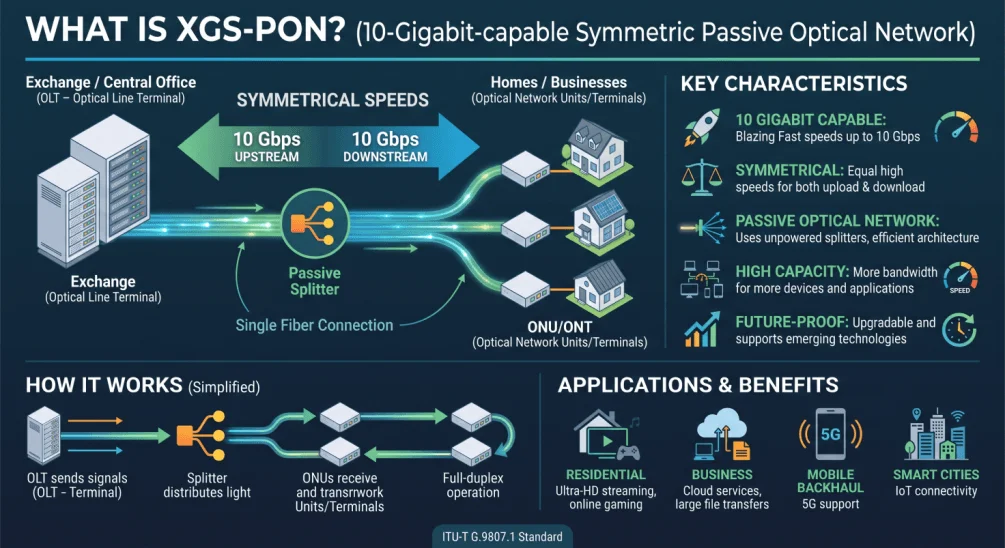
XGS-PON stands for 10-Gigabit Symmetric Passive Optical Network. It delivers symmetrical 10Gbps speeds over fibre, enabling multi-gigabit residential and business broadband. Openreach, CityFibre, Hyperoptic, YouFibre and nexfibre are rolling it out across the UK.
If you have been shopping for broadband recently, you might have seen providers talking about “XGS-PON” technology. It is the reason some providers offer speeds like 2.3Gbps or even 8Gbps, often with upload speeds that match the download. XGS-PON is a key enabler of the next generation of UK broadband, but its name does not exactly make it easy to understand. The acronym stands for 10-Gigabit Symmetric Passive Optical Network. The “X” is the Roman numeral for ten, “G” stands for Gigabit, “S” means Symmetric, and PON stands for Passive Optical Network.
The ITU-T G.9807.1 standard was ratified in 2016, and it is the technology behind most multi-gigabit residential tiers that are now reaching the market. This guide explains what XGS-PON is, how it works, why it matters for your broadband, and which providers are already using it across the UK.
The Short Version What Is XGS PON
- XGS-PON delivers symmetrical 10Gbps speeds – equal upload and download capacity
- It runs on the same fibre cables as GPON, using different wavelengths to coexist
- Openreach is rolling out XGS-PON to 1 million+ premises, with speeds up to 8.5Gbps
- Alt-nets like Hyperoptic, nexfibre and YouFibre already use XGS-PON for symmetric gigabit services
- EE launched the UK’s first 8Gbps residential service on Openreach XGS-PON in August 2026
- YouFibre has offered 8Gbps XGS-PON services for several years
What is XGS-PON?
XGS-PON is a fibre broadband technology that delivers symmetrical speeds of up to 10Gbps over existing fibre infrastructure. It is the upgrade to GPON, offering equal upload and download capacity.
Unlike GPON (Gigabit Passive Optical Network), which offers asymmetrical speeds (typically 2.5Gbps down and 1.25Gbps up), XGS-PON provides equal upload and download speeds. This symmetry is crucial for modern internet usage where uploading large files, video conferencing, cloud backups and content creation are now standard household activities.
What are symmetrical speeds?
Symmetrical speeds mean your upload speed matches your download speed. With a 1Gbps symmetrical connection, you can download and upload files at the same gigabit speed. This is a significant advantage over asymmetric broadband, where uploads are typically much slower than downloads. Symmetrical speeds are essential for video conferencing, cloud backups, large file sharing, and content creation.
Why “Passive Optical Network”?
The “passive” part means there are no powered electronics between the exchange and your home. Instead, optical splitters are used to share a single fibre connection between multiple premises. This makes the network highly reliable, energy efficient and cost-effective.
How Does XGS-PON Work?
Wavelength Coexistence
One of XGS-PON’s smartest features is its ability to coexist with existing GPON networks on the same fibre cable. becaus they runs at different wavelengths:
- GPON uses 1490nm down / 1310nm up
- XGS-PON uses 1577nm down / 1270nm up
Because these wavelengths are different, both standards can operate simultaneously on the same fibre through the same splitters. This means Openreach and other network operators can upgrade their networks without digging up streets or replacing entire fibre infrastructure.
What are wavelengths in fibre broadband?
In fibre optic broadband, wavelengths are different colours of light used to send data down the same fibre cable. Think of them like separate lanes on a motorway. GPON uses one wavelength (1490nm down, 1310nm up) while XGS-PON uses different wavelengths (1577nm down, 1270nm up). Because they use different “lanes”, they can both run on the same fibre without interfering with each other.
The Overlay Upgrade Path
Because XGS-PON coexists with GPON on live fibre, operators can upgrade surgically: install XGS-PON cards at the exchange, then swap ONTs (Optical Network Terminals, the box on your wall) only for customers who buy up to faster tiers. Early adopters and premium tiers migrate first while the GPON base keeps running untouched. No trenching, no neighbourhood outages, no stranded assets.
This is why multi-gigabit tiers appeared across whole footprints almost overnight once XGS-PON equipment matured. It also allows for a gradual migration from GPON to XGS-PON without disrupting existing users, giving operators better ROI on their existing infrastructure.
What is an Optical Network Terminal (ONT)?
An ONT is the small box installed on your wall that converts the fibre optic light signals from your broadband provider’s network into electrical signals your router can understand. It is the interface between the fibre cable coming into your property and your home network. When you upgrade from GPON to XGS-PON, the ONT usually needs to be replaced because it is tuned to the specific wavelengths and speeds of the network technology. Some providers build the ONT directly into the router, while others keep it as a separate box on the wall.
XGS-PON vs GPON: The Key Differences
GPON offers 2.5Gbps down and 1.25Gbps up (asymmetric). XGS-PON offers 10Gbps symmetric. XGS-PON coexists with GPON on the same fibre, allowing gradual network upgrades.
| Feature | GPON | XG-PON | XGS-PON |
|---|---|---|---|
| Standard | ITU-T G.984.x | ITU-T G.987.x | ITU-T G.9807.1 |
| Download Speed | 2.5 Gbps | 10 Gbps | 10 Gbps |
| Upload Speed | 1.25 Gbps | 2.5 Gbps | 10 Gbps |
| Symmetry | Asymmetric | Asymmetric | Symmetric |
| Primary Use | Residential broadband | Enhanced residential | Enterprise, SMB, high-performance applications |
| Coexistence | N/A | With GPON | With GPON and XG-PON |
While GPON solves today’s basic needs, XGS-PON prepares networks for future demands. XGS-PON is considered future-proof for both residential and enterprise users, capable of meeting increasing bandwidth needs well into the future.
Why XGS-PON Matters for UK Broadband Customers
Symmetrical Speeds Change How We Use the Internet
A 10Gbps upstream makes cloud backup, 4K video calling, live streaming, and content creation first-class home activities. It shifts how households produce media, not just consume it. With symmetrical speeds, you can upload large files to the cloud as quickly as you download them, making tasks like video editing, remote work, and large-scale file sharing genuinely practical for the average home.
The Multi-Gigabit Marketing War
The multi-gig marketing war – 2, 5, and 8-gigabit broadband packages are XGS-PON products. ISPs (Internet Service Providers) compete and advertise on these tiers, with EE launching 2.3Gbps and 8Gbps services on XGS-PON and YouFibre offering 8Gbps services for several years.
Which UK Broadband Providers Use XGS-PON?
Openreach is rolling out XGS-PON to 1 million+ premises. EE launched 8Gbps on XGS-PON in August 2026. Hyperoptic, YouFibre, nexfibre, CityFibre and Freedom Fibre also use XGS-PON technology.
-
Openreach: Openreach is planning a wider rollout of XGS-PON technology across its Full Fibre network. The business aims to make enhanced speeds available to more than one million premises over the next 12 months, building on an XGS-PON pilot launched in March 2026 across 40,000 residential premises in Guildford and surrounding areas. Over the next five years, Openreach aims to extend XGS-PON to around one-third of its Full Fibre network.
-
EE: EE launched 8Gbps broadband on XGS-PON in August 2026. The service, branded as Advanced Full Fibre, is initially available in Guildford, Woking and surrounding areas.
- nexfibre: nexfibre, the Liberty Global joint venture with Telefónica and InfraVia Capital Partners, has built its entire network on XGS-PON technology. giffgaff Broadband launched on nexfibre’s all-XGS-PON network in September 2025, benefiting from symmetrical speeds and scalable infrastructure.
- Hyperoptic: Hyperoptic, founded in 2011, operates its own XGS-PON Full Fibre network built directly into apartment blocks across UK cities. They offer symmetric speeds up to 1Gbps and have reached around 1.9 million UK premises.
- YouFibre: YouFibre has been offering 8Gbps XGS-PON services for several years, making them one of the pioneers of multi-gigabit residential broadband in the UK.
- CityFibre: CityFibre, the UK’s largest independent full fibre platform, has confirmed that its entire network is future-proofed for XGS-PON, enabling symmetrical speeds and 10Gbps capability.
- Freedom Fibre: Freedom Fibre, an altnet building full-fibre infrastructure across the North West and West Midlands, uses XGS-PON technology capable of delivering speeds up to 10Gbps.
The Future Beyond XGS-PON
The industry is already developing standards beyond XGS-PON, including 25G-PON and 50G-PON. The move to XGS-PON prepares networks for those future upgrades while making use of the same fibre infrastructure. Openreach has already run a “hyper-fast” 50Gbps broadband trial in the UK.
XGS-PON serves as a bridge to these next-generation technologies, providing the capacity and scalability needed to support emerging applications like AI, 8K streaming, advanced cloud computing, and the expanding Internet of Things.
Related Articles
Boost Your Broadband: Tips for Speed and Reliability
Are you tired of buffering videos, slow loading pages, and unreliable internet connections? Upgrading your broadband package/best-broadband-deals-this-week/ might be the answer, but before you start searching or considering a new broadband package, have a look at these practical tips to help optimise your existing broadband connection. Understanding Your Broadband Speed The first step to improving […]

Onestream Broadband Deals and Review – Are they any good?
Onestream Broadband Comprehensive Review Finding the right broadband provider can be tricky, especially with so many options available. If you’re looking for affordable, reliable internet in the UK, Onestream Broadband might be worth considering. Launched in 2018, Onestream aims to offer budget-friendly packages with competitive speeds, making high-speed internet more accessible. In this article, we’ll […]
Should You Care About XGS-PON?
XGS-PON is the technology enabling multi-gigabit broadband. It is the future of UK fibre networks. If you want symmetric speeds and future-proofing, it matters.
If you are on a standard broadband package and do not have a need for multi-gigabit speeds, XGS-PON might not be immediately relevant to you. But it matters because it represents the direction the entire broadband industry is moving.
For households uploading large files, gaming, working from home with video collaboration, or running smart home ecosystems, XGS-PON offers a genuine upgrade in performance. And as Openreach expands its XGS-PON footprint to more than one million premises over the next year, this technology will become available to many more UK households.
Pros and Cons of XGS-PON
| Pros | Cons |
|---|---|
| Symmetric 10Gbps speeds – upload matches download | Requires new ONT at your property |
| Coexists with GPON – no street digging needed | Multi-gigabit packages are more expensive |
| Future-proof – supports 25G-PON and 50G-PON upgrades | Not yet available in all areas |
| Enables business-grade services on residential fibre | Most households do not need 10Gbps yet |
| Rolling out across Openreach FTTP footprint | Consumer devices rarely support >1Gbps Wi-Fi |
XGS-PON Frequently Asked Questions
What does XGS-PON stand for?
XGS-PON stands for 10-Gigabit Symmetric Passive Optical Network. The "X" is the Roman numeral for ten, "G" stands for Gigabit, "S" stands for Symmetric, and PON stands for Passive Optical Network.
What is the difference between GPON and XGS-PON?
GPON offers asymmetrical speeds (2.5Gbps down, 1.25Gbps up) while XGS-PON offers symmetrical 10Gbps both down and up. XGS-PON also coexists with GPON on the same fibre using different wavelengths, allowing for gradual network upgrades.
Is XGS-PON available in my area?
Openreach is rolling out XGS-PON to more than one million premises over the next 12 months, with pilot areas including Guildford and Woking. Alt-nets including CityFibre, Hyperoptic, nexfibre, YouFibre and Freedom Fibre already offer XGS-PON services in many urban areas.
What speeds can I get with XGS-PON?
XGS-PON supports symmetrical speeds up to 10Gbps. Commercial retail services currently range from 1Gbps to 8Gbps, depending on the provider and package. Openreach offers up to 8.5Gbps wholesale.
Can XGS-PON and GPON work on the same fibre?
Yes. XGS-PON uses different wavelengths from GPON (1577nm down / 1270nm up vs GPON's 1490nm down / 1310nm up), allowing both technologies to coexist on the same fibre infrastructure through the same splitters.
Why is symmetric speed important?
Symmetric speeds mean your upload is as fast as your download. This is crucial for modern internet usage including video conferencing, cloud backups, file sharing, content creation, and remote working where uploading large files is increasingly common.
Does XGS PON mean I automatically get 10 Gbps speeds at home
Receiving service from an XGS-PON network does not mean you automatically get 10 Gbps speeds on your laptop. Internet providers sell various package tiers over this infrastructure, such as 500 Mbps, 1 Gbps, or 2.5 Gbps plans.
The 10 Gbps capacity represents the total theoretical bandwidth of the shared optical strand serving your local splitter group. Your household speed depends entirely on the specific tariff you purchase from your provider and the capabilities of your local router hardware.
Do I need new cables installed outside my house for XGS PON
Upgrading to XGS-PON requires no new optical cables outside your property if you already have a modern full-fibre line installed. The technology runs over the exact same single-mode glass fibre strands used by older GPON connections.
The upgrade process only requires changing the electronic equipment at each end of the line. The network provider updates the optical line card inside their local exchange and swaps your indoor wall box for an XGS-PON compatible terminal.
What hardware do I need inside my house for XGS PON
You need an XGS-PON compatible Optical Network Terminal mounted on your wall to receive the optical signal from the street. This box contains a specialized optical receiver that reads the 1577 nanometre and 1270 nanometre light wavelengths.
You also need a broadband router equipped with a 2.5 Gbps or 10 Gbps WAN port to connect to the optical box via an Ethernet cable. If your router only has standard 1 Gbps ports, your maximum throughput will be physically capped at around 940 Mbps regardless of how fast your internet package is.
Is XGS PON better for gaming than standard broadband
XGS-PON offers noticeable advantages for online gaming by reducing transmission latency and eliminating queue bottlenecks. The increased bandwidth prevents latency spikes when other household devices stream video while you play.
The symmetrical upstream capacity also ensures that outgoing player position data reaches game servers without delay. While it will not change your raw personal skill, pairing a low-latency optical connection with an optimised gaming setup creates a smooth, responsive multiplayer experience.
How does XGS PON compare to traditional copper broadband
Traditional copper broadband relies on electrical signals sent over metal telephone wires, which lose strength rapidly over physical distance. Copper lines suffer from electrical interference, corrosion, and severe speed decay the further you live from the exchange.
XGS-PON uses pulses of laser light traveling through pure glass strands, experiencing minimal signal loss over distances up to 20 kilometres. You can read more about how glass lines differ from copper wires to understand why optical networks provide superior reliability and weather resistance.
Will switching to an XGS PON provider cause long downtime
Switching to an independent network running XGS-PON typically involves zero downtime on your existing broadband line. Because the new provider runs its own dedicated optical cable into your home, your old service remains fully active until the new installation is complete.
Are XGS PON broadband packages more expensive
XGS-PON packages are often priced competitively against older, slower broadband packages. Because independent challenger networks build these networks to win customers from legacy providers, their introductory pricing is frequently lower than standard national tariffs.